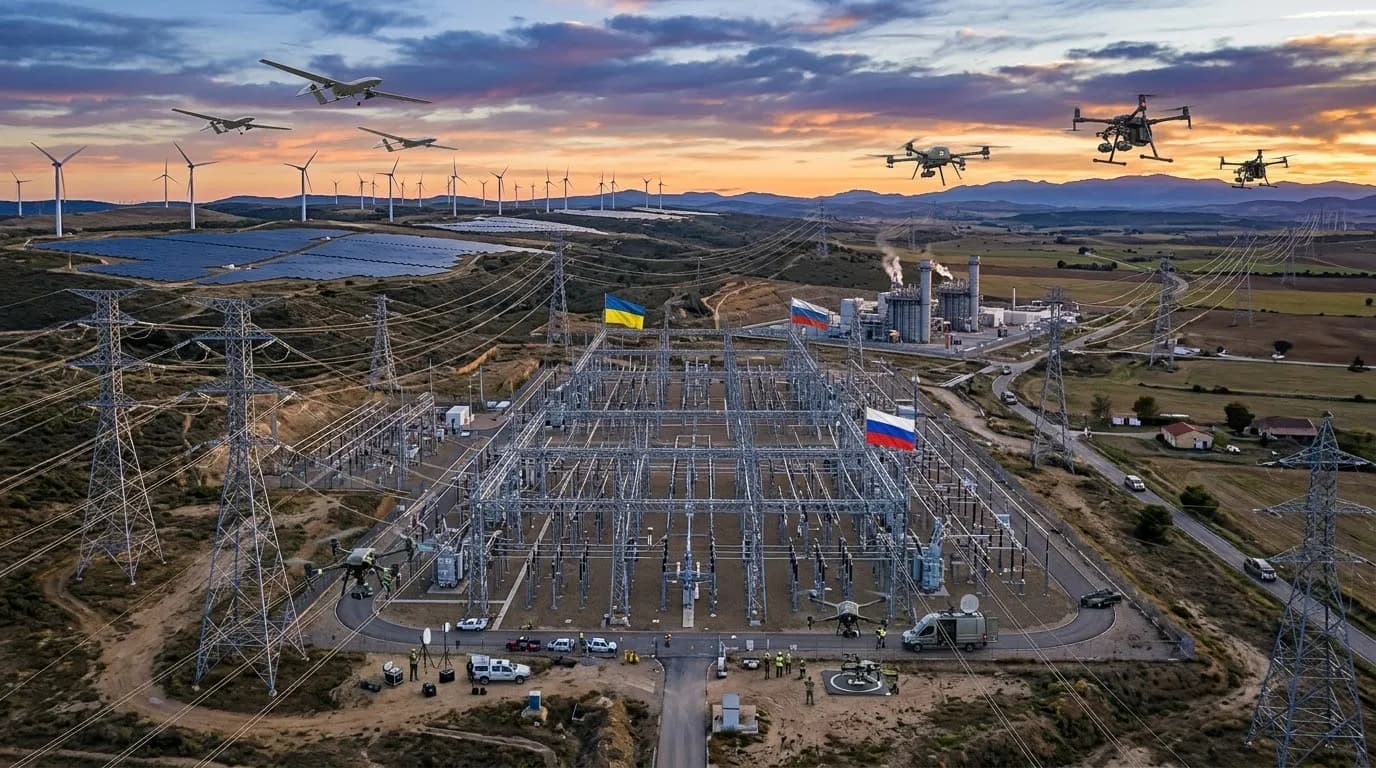
China and U.S. Compete to Reinvent Agriculture
China's new plan targets 725 million tonnes of grain by 2030, while U.S. exports hit $171 billion in 2025.
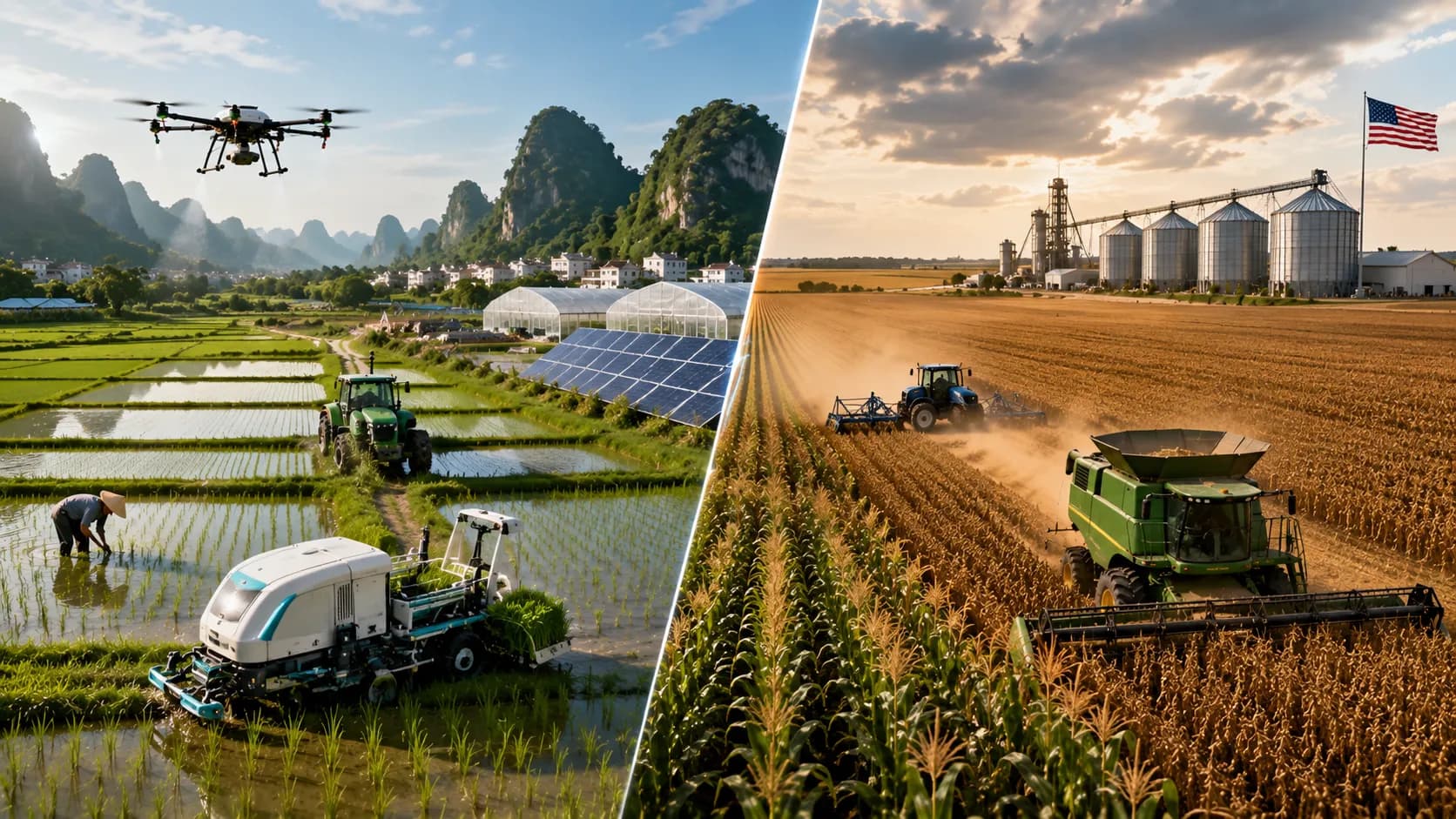
China and U.S. Compete to Reinvent Agriculture
China and the United States are turning agriculture into another field of strategic competition in 2026. Both countries are investing heavily in food security, agricultural technology and supply chains, but they are following fundamentally different models.
China is concentrating on land productivity, seeds, agricultural machinery and technological self-sufficiency, while the United States is placing greater emphasis on farm income, domestic fertilizer production, agricultural research and private-sector innovation.
The competition matters far beyond farming. Together, the two countries are major agricultural producers, consumers and traders, meaning decisions taken in Beijing and Washington can influence global food prices, fertilizer markets and agricultural technology.
China Invests in Producing More From the Same Land
China's central problem is straightforward: it must provide food security for a huge population despite limited agricultural land and water resources.
Beijing's new 2026–2030 agricultural modernization plan therefore aims to raise China's comprehensive grain-production capacity to approximately 725 million tonnes by 2030.
Rather than dramatically expanding farmland, China wants to increase production per hectare.
Its strategy combines better seeds, improved soil, modern agricultural machinery, irrigation, biotechnology and artificial intelligence.
China built or renovated approximately 5.05 million hectares of high-standard farmland in 2025, bringing its total high-standard farmland area above one billion mu. Agricultural science and technology contributed more than 64 percent to agricultural output, while the overall mechanization rate for cultivation, planting and harvesting reached 76.7 percent.
More than 300,000 agricultural drones are now operating across the country.
Agriculture is consequently becoming another component of China's technological modernization.
Seeds Become Strategic Technology
One of China's most important investment areas is seed technology.
Beijing wants higher-yielding crops that are more resistant to disease, drought and difficult environmental conditions. Its latest agricultural strategy includes biotechnology, gene editing and AI-supported agricultural development.
The strategic reasoning resembles China's approach to semiconductors.
Dependence on foreign technology creates vulnerability.
Dependence on foreign food can create another.
China is therefore attempting to strengthen domestic seed capabilities while protecting black soil, rehabilitating saline agricultural land and modernizing high-potential farmland.
Its revised agricultural legislation also emphasizes satellite monitoring, big data, cloud computing and artificial intelligence for farmland management.
America Invests in Agricultural Resilience
The United States starts from a different position.
America already possesses enormous highly productive agricultural regions and remains one of the world's largest agricultural exporters. U.S. agricultural exports reached approximately $171 billion in 2025.
Washington's immediate priority in 2026 is therefore not simply producing more food.
It is protecting the resilience and profitability of the agricultural system.
The U.S. Department of Agriculture announced $500 million in July to expand domestic fertilizer manufacturing following major disruptions to international fertilizer markets.
The objective is strategically significant: America wants farmers to become less vulnerable to fertilizers imported through unstable international supply chains.
Research Becomes America's Advantage
The United States is also increasing investment in agricultural research infrastructure.
USDA announced $125 million annually for modernization of agricultural research facilities at American land-grant universities. Projects can include laboratories, specialized research facilities and large research complexes.
Artificial intelligence and precision agriculture are increasingly important.
USDA research plans emphasize AI, machine learning, autonomous sensors, genomics and precision technologies capable of providing farm-specific recommendations while improving yields and reducing input costs.
Washington is therefore attempting to preserve one of America's traditional advantages: connecting universities, government research laboratories, technology companies and commercial agriculture.
Washington Is Spending Heavily to Protect Farmers
There is another major difference between the two systems.
American agricultural policy is currently placing considerable emphasis on financial protection.
Government payments to U.S. farmers were already projected at approximately $44 billion for 2026, before the administration requested another $11 billion following economic disruption associated with the Middle East conflict. If fully approved, support could reach around $55 billion.
USDA is simultaneously investing up to $310 million in conservation partnerships involving soil health, water, precision agriculture and farm productivity.
America's agricultural strategy therefore combines technology investment with a substantial financial safety net.
China Focuses on Independence, America on Resilience
The difference between the two strategies can be summarized clearly.
China's priority is agricultural self-sufficiency.
Beijing wants to reduce vulnerabilities associated with imported soybeans, seeds, technology and other agricultural inputs while extracting greater productivity from limited land.
America's priority is agricultural resilience and competitiveness.
Washington wants to protect farm incomes, secure fertilizer supplies, modernize research and maintain America's position as one of the world's most productive agricultural exporters.
Yet both countries are increasingly reaching the same conclusion:
future agricultural power will depend on technology.
Agriculture Becomes Part of National Security
The U.S.–China competition is also transforming food into a geopolitical issue.
China remains dependent on international agricultural markets, including imports of soybeans and other commodities. Beijing's latest strategy explicitly calls for more stable and controllable overseas agricultural supply channels.
At the same time, China committed this year to purchase at least $17 billion of U.S. agricultural products annually between 2026 and 2028, demonstrating how agriculture remains deeply embedded in the broader U.S.–China economic relationship.
Food trade can therefore become both a source of cooperation and a geopolitical bargaining instrument.
The Next Agricultural Superpower Will Be Technological
The comparison between China and the United States reveals where global agriculture is heading.
The next agricultural revolution will not be determined simply by which country possesses the most farmland.
It will increasingly depend on who develops the best seeds, agricultural robots, autonomous machinery, AI systems, irrigation technologies, fertilizers and biological technologies — and who can secure the supply chains behind them.
China is building a highly coordinated state-led agricultural modernization system.
The United States is combining government investment with universities, large agricultural companies and technology-driven private enterprise.
Their models are different, but their objective is increasingly similar:
to ensure that food production becomes a source of national strength rather than strategic vulnerability.
As climate pressure, geopolitical competition and population growth reshape global food systems, agriculture is becoming something much larger than an economic sector.
It is becoming part of the technological and national-security competition between the world's major powers.
Ahmet Balakan
Contributing writer at EUReflect.
Follow EUReflect
See more of our reporting on Google
Mark EUReflect as a preferred source and our stories are ranked higher for you in Top Stories, Discover and Google News — and carry a “preferred” badge when they are cited in AI results.
Add EUReflect as a preferred source