China’s Tech Power Reshapes Asia
Open AI models from Chinese labs could accelerate adoption across Asia, offering low-cost, customizable alternatives to Western systems.
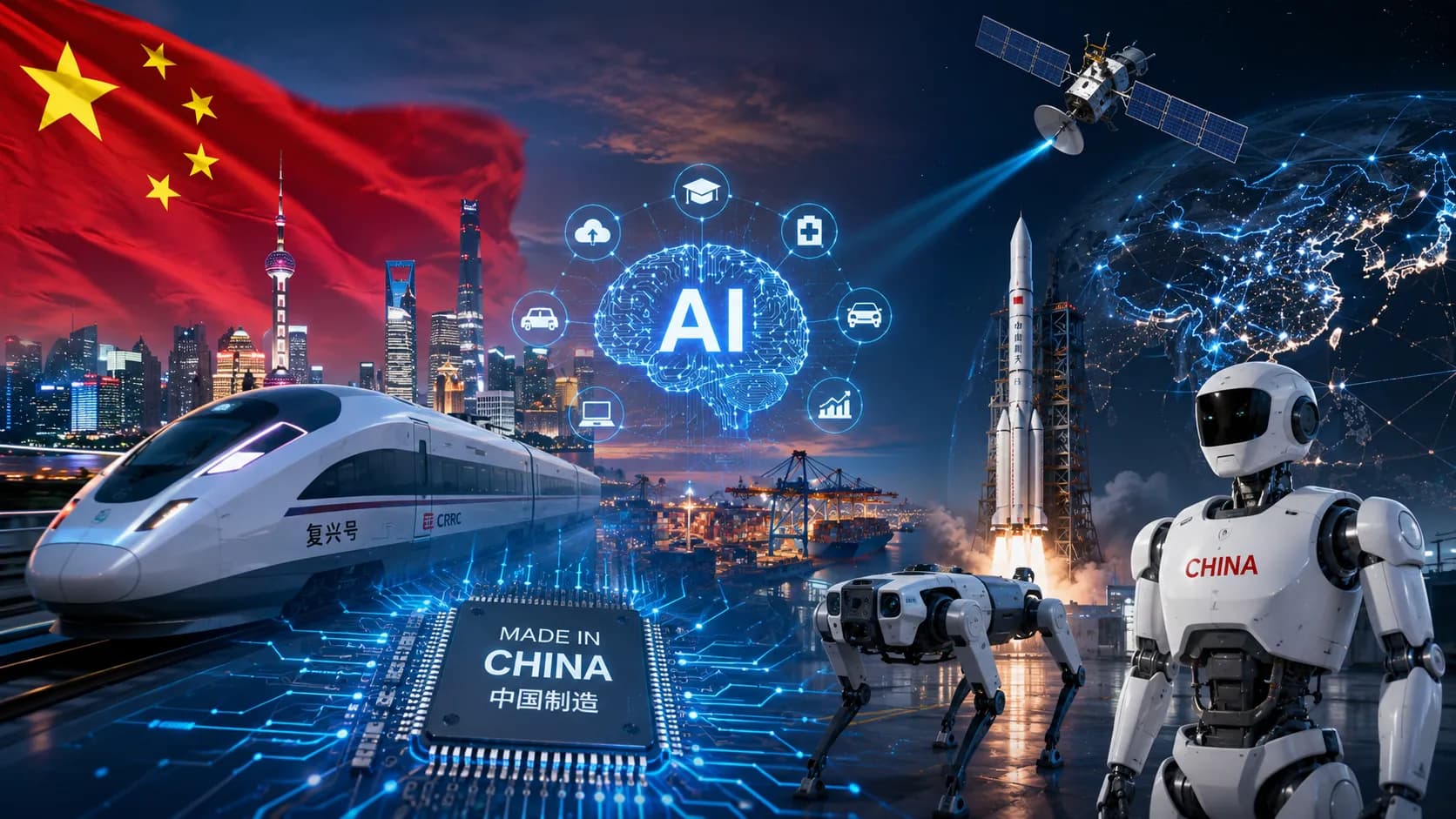
China’s technological rise is entering a new phase in 2026. Beijing is no longer concentrating primarily on becoming self-sufficient in individual technologies. Its broader objective is to build an integrated technological ecosystem stretching from artificial intelligence and semiconductors to humanoid robots, quantum computing, telecommunications and advanced manufacturing.
The shift has major implications for Asia.
China’s technological strength increasingly comes not from leadership in a single field, but from its ability to connect research, manufacturing capacity, infrastructure, government support and an enormous domestic market. Beijing’s new Five-Year Plan for 2026–2030 places technological self-reliance and the widespread adoption of artificial intelligence at the center of the country’s economic strategy.
AI Moves From Models to the Economy
Artificial intelligence has become perhaps the most visible part of China's technology strategy.
Chinese companies are increasingly competing with leading American developers in foundation models while pursuing a different path toward commercialization. Beijing wants AI embedded across manufacturing, logistics, healthcare, transportation and public services rather than concentrated primarily in standalone consumer applications.
China is also aggressively promoting open AI models. A March 2026 assessment by the U.S.-China Economic and Security Review Commission noted that many Chinese laboratories are releasing model weights and software openly, potentially accelerating adoption by developers and companies outside China.
That strategy could prove particularly important across Asia, where companies and governments may prioritize inexpensive and customizable AI systems.
The scale of investment is also growing rapidly. On August 23, Alibaba announced a HK$80 billion — approximately $10.2 billion — Hong Kong share placement, with the proceeds intended for AI chips, computing infrastructure and model development.
The message is clear: China's largest technology companies increasingly view AI infrastructure as a strategic investment comparable to the internet and cloud-computing expansions of previous decades.
Robots Become China's New Industrial Bet
Perhaps the clearest demonstration of China's emerging technological advantage can be found in robotics.
China has built a powerful combination of electronics suppliers, battery manufacturers, electric-motor producers, precision manufacturing companies and AI developers. That supply chain is now being redirected toward humanoid and quadruped robots.
The World Robot Conference in Beijing this month highlighted how quickly the industry is expanding. Unitree CEO Wang Xingxing said robotics could be approaching its own “ChatGPT moment,” although he cautioned that truly general-purpose robotic intelligence could still be several years away.
The industrial momentum is already visible.
Chinese humanoid robot manufacturer Unitree made a dramatic Shanghai stock-market debut this month after raising about 6.1 billion yuan, or roughly $904 million. The company has become one of China's leading exporters of humanoid robots and robotic dogs.
China's advantage is increasingly about scale.
Technologies originally developed as expensive laboratory prototypes can be redesigned, manufactured and commercialized through China's enormous industrial ecosystem. Reuters recently documented how Chinese companies have transformed advances in quadruped robotics into relatively inexpensive mass-produced systems.
This resembles the strategy that helped China become dominant in electric vehicles, batteries and solar panels.
From Electric Vehicles to Intelligent Machines
China's electric-vehicle revolution is now feeding directly into the robotics industry.
Electric vehicles require batteries, sensors, electric motors, power-management systems, advanced manufacturing and increasingly sophisticated software. Many of the same components are essential for humanoid robots.
Chinese automakers are therefore beginning to move into robotics themselves.
Chery's robotics subsidiary AiMOGA, for example, has already delivered more than 3,000 robots globally, including about 2,000 units deployed overseas across more than 60 countries. The company is considering an IPO as it seeks to expand production and international sales.
The development illustrates a wider transformation.
China's automotive industry is gradually evolving into a broader intelligent-machine industry in which autonomous vehicles, industrial robots, humanoids and AI systems increasingly share technologies and supply chains.
Semiconductors Remain the Critical Weakness
Despite this progress, China still faces an important technological vulnerability: advanced semiconductors.
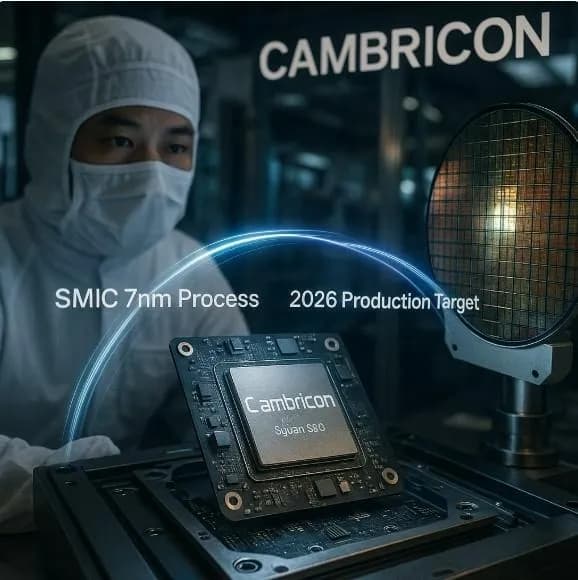
U.S. export restrictions have attempted to limit China's access to the most sophisticated chips and semiconductor manufacturing equipment. Chinese companies have responded by accelerating domestic chip development and investing heavily in alternative computing infrastructure.
But the gap has not completely disappeared.
Recent reporting indicates that Chinese technology companies continue to seek access to Nvidia accelerators even as domestic alternatives improve. Some Chinese firms have received limited quantities of Nvidia H200 processors, while Washington and Beijing continue to clash over access to advanced computing technology.
This makes semiconductors one of the central contradictions in China's technological rise.
China possesses enormous manufacturing capacity and increasingly competitive AI models, but access to the world's most advanced computing hardware remains strategically important.
For Beijing, reducing that dependence is therefore not simply an economic objective. It has become a national-security priority.
China Is Already Looking Beyond 5G
While semiconductor competition continues, Beijing is simultaneously preparing for the next generation of telecommunications.
China is investing heavily in 6G research, with authorities seeking independently developed technical solutions before the end of the decade. The country's strategy links future communications networks with artificial intelligence, sensing technologies, satellites and industrial applications.
The importance of 6G extends far beyond faster smartphones.
Future networks could connect autonomous vehicles, factories, robots, satellites, drones and AI systems with extremely low latency.
For China, leadership in 6G would therefore provide something potentially more valuable than telecommunications market share: influence over the infrastructure connecting the next generation of intelligent machines.
Quantum Technology Is the Longer-Term Race
Quantum technology represents another major pillar of China's strategy.
Beijing's 2026–2030 development blueprint identifies quantum technologies alongside AI, robotics and other emerging industries as strategic priorities.
China has already built substantial capabilities in quantum communications and continues investing in quantum computing.
Unlike commercial AI, however, quantum technology remains a longer-term competition. Many applications are still experimental, and it remains uncertain which architectures will ultimately become commercially viable.
Nevertheless, Beijing appears willing to invest years ahead of mass-market demand.
That approach reflects a broader feature of China's technology strategy: the government is attempting to identify industries that could become strategically important in the 2030s and build domestic ecosystems before those markets fully mature.16*Asia Is Becoming the Main Arena
China's technological rise cannot be separated from the wider Asian technology ecosystem.
Taiwan remains crucial to advanced semiconductor manufacturing. South Korea is a global leader in memory chips and electronics. Japan retains significant strengths in semiconductor materials, precision manufacturing and industrial robotics. Singapore is emerging as a major AI and data infrastructure hub.
China's advantage lies elsewhere: scale and integration.
It has one of the world's largest consumer markets, the world's largest manufacturing ecosystem, enormous renewable-energy and battery industries, extensive digital infrastructure and an increasingly sophisticated domestic technology sector.
This allows Beijing to connect AI software with physical production in ways few countries can replicate.
The competition in Asia is therefore becoming less about individual inventions and more about complete technology ecosystems.
China's Real Strength Is Industrialization
China still does not dominate every advanced technology.
The United States remains exceptionally strong in frontier AI research and high-end semiconductor design. Taiwan dominates leading-edge chip manufacturing, while Japan and South Korea maintain important technological advantages in several critical industries.
But China's greatest strength may be its ability to turn technology into industrial scale.
A laboratory breakthrough becomes strategically important only when it can be manufactured cheaply, deployed widely and integrated into the broader economy.
China demonstrated that capability with solar panels.
It demonstrated it again with batteries and electric vehicles.
Robotics and artificial intelligence may be next.
The technological balance in Asia is therefore shifting toward a new question. The decisive competition will not simply be who invents the next major technology.
It will be who can manufacture it, deploy it and build an entire economy around it first.
Ahmet Balakan
Contributing writer at EUReflect.
Follow EUReflect
See more of our reporting on Google
Mark EUReflect as a preferred source and our stories are ranked higher for you in Top Stories, Discover and Google News — and carry a “preferred” badge when they are cited in AI results.
Add EUReflect as a preferred source