Climate Powers Choose Different Paths
The EU's binding 90% cut by 2040 contrasts with China's industrial strategy and US deregulation, creating a fragmented global approach.
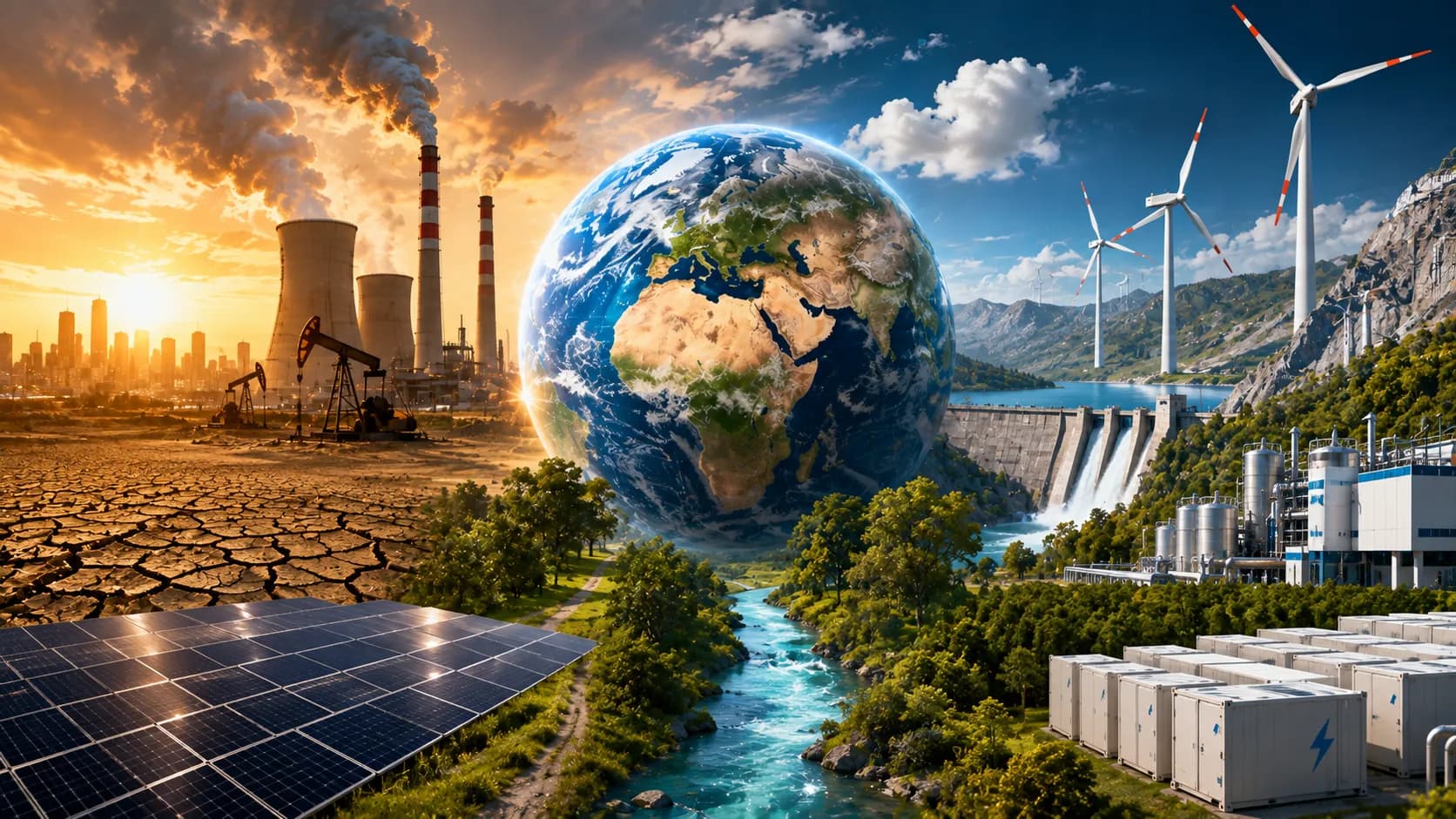
Climate Powers Choose Different Paths
The world's largest economies are entering a new phase of climate policy in 2026. The European Union is tightening legally binding emissions targets, China is combining massive clean-energy deployment with industrial policy, India is rapidly expanding renewable capacity, Brazil is emphasizing forests and implementation, while the United States is moving in the opposite regulatory direction under President Donald Trump.
The result is increasingly clear: the major powers agree that energy systems are changing, but they disagree sharply over how governments should manage that transition.
Europe: Regulation First
The European Union continues to pursue the most regulation-driven climate strategy among the major economic powers.
In March, the EU formally adopted a binding target to reduce net greenhouse-gas emissions by 90 percent by 2040 compared with 1990 levels, reinforcing its objective of climate neutrality by 2050. At least 85 percentage points of that reduction are expected to be achieved domestically, although limited use of international carbon credits will be permitted from 2036.
Brussels is simultaneously modifying its Emissions Trading System to encourage industrial decarbonization while protecting European competitiveness. A July proposal includes additional support through an Industrial Decarbonisation Bank and changes involving free allowances and the Carbon Border Adjustment Mechanism.
Europe's strategy is therefore increasingly based on a combination of carbon pricing, industrial subsidies and legally binding targets.
Its greatest challenge is cost. European governments must decarbonize without driving energy-intensive manufacturing and investment toward countries with cheaper energy and weaker environmental requirements.
China: Climate Policy Becomes Industrial Policy
China is following a fundamentally different model.
Beijing continues to target peak carbon dioxide emissions before 2030 and carbon neutrality before 2060. Its new 2026–2030 carbon-peaking action plan calls for carbon intensity to fall 17 percent from 2025 levels by 2030, while non-fossil energy should reach 25 percent of total energy consumption.
China also plans to expand its national carbon market and accelerate low-carbon transformation across energy, industry, transportation and urban development.
But China's most important climate instrument may not be regulation.
It is manufacturing.
China has developed enormous production capacity in solar panels, batteries, electric vehicles, wind equipment and associated supply chains. Climate policy therefore serves two objectives simultaneously: reducing long-term emissions and strengthening Chinese dominance over technologies that other countries increasingly need for their own energy transitions.
This makes China's strategy particularly powerful internationally. Beijing can influence global decarbonization not only through diplomacy but through the price and availability of clean technologies.
United States: Energy Security Replaces Climate Leadership
The United States has undergone the most dramatic policy reversal.
Washington formally left the Paris Agreement again in January 2026, meaning the world's largest economy no longer has an active Paris climate pledge.
The Trump administration has also rolled back important federal climate regulations. In February, the Environmental Protection Agency rescinded the 2009 greenhouse-gas Endangerment Finding and federal greenhouse-gas standards for motor vehicles.
Some elements of the previous climate architecture nevertheless remain contested in the courts. Earlier this month, a federal appeals court ruled that the EPA could not claw back approximately $20 billion in clean-energy grants awarded under the previous administration.
Washington's emphasis has consequently shifted toward energy abundance, electricity reliability, industrial production and national security.
That shift became even clearer on August 26, when the White House declared a national emergency concerning vulnerabilities in the U.S. bulk-power system amid rapidly growing electricity demand from artificial intelligence, data centers, advanced manufacturing and defence production.
The American debate is therefore increasingly less about climate leadership and more about who can produce enough affordable and reliable energy to sustain technological and industrial dominance.
India: Build Clean Energy Without Sacrificing Growth
India faces a different challenge.
New Delhi must reduce the carbon intensity of its development while supplying affordable electricity to a rapidly expanding economy and population.
India crossed 300 GW of non-fossil electricity capacity in July, including approximately 165 GW of solar and 58 GW of wind. Non-fossil sources now represent more than 54 percent of installed generating capacity. India remains committed to reaching 500 GW by 2030.
But India's experience also demonstrates why installing renewable capacity is only part of the transition.
Its transmission network has struggled to keep pace with renewable development. India is now considering low-cost loans for projects affected by grid constraints after renewable producers suffered an estimated $470 million in losses since February 2025.
India's priority is therefore increasingly moving from simply constructing solar and wind farms toward building the grids, storage and financing systems necessary to use that electricity.
Brazil: Forests Become Strategic Assets
Brazil represents another model.
Its climate strategy gives far greater importance to forests, agriculture, land use and biodiversity than the approaches adopted by China, Europe or the United States.
Following COP30 in Belém, Brazil is attempting to move from international climate commitments toward implementation. Its Plano Clima 2024–2035, launched in March, establishes a national roadmap connecting sectoral policies with Brazil's emissions targets and its objective of reaching net zero by 2050.
Brazil is also associated with new international mechanisms designed to mobilize long-term financing for tropical forest conservation, including the Tropical Forest Forever Facility advanced through the COP30 implementation agenda.
Brazil's strategic argument is essentially that standing forests should possess measurable economic value.
If that approach succeeds, climate finance could transform forests from environmental responsibilities into strategic economic assets.
Climate Policy Is Becoming Economic Competition
The comparison reveals a larger transformation.
Climate policy is no longer primarily environmental policy.
For Europe, it is becoming regulation and industrial competitiveness.
For China, it is manufacturing and technological dominance.
For the United States, it is increasingly energy security and industrial power.
For India, it is development combined with renewable expansion.
For Brazil, it is forest protection, climate finance and natural-resource diplomacy.
The International Energy Agency warns that the latest national climate pledges collectively do not imply faster annual emissions reductions than the previous generation of commitments. If current NDC energy targets are achieved, global energy-related emissions would decline by only around 0.3 percent annually through 2035.
That exposes the central contradiction of global climate politics in 2026.
Major powers increasingly accept that the global energy system will change, but they want that transformation to strengthen — rather than weaken — their own economies.
The climate race is therefore becoming an industrial race.
The country that controls the technologies, minerals, electricity systems, capital and manufacturing capacity required for the energy transition may gain an economic advantage extending far beyond climate policy itself.
Ahmet Balakan
Contributing writer at EUReflect.
Follow EUReflect
See more of our reporting on Google
Mark EUReflect as a preferred source and our stories are ranked higher for you in Top Stories, Discover and Google News — and carry a “preferred” badge when they are cited in AI results.
Add EUReflect as a preferred source