Europe’s New Dividing Lines
Defence spending across the EU is set to hit €454bn in 2026, with 23 member states already meeting the 2% GDP threshold, but priorities diverge sharply.
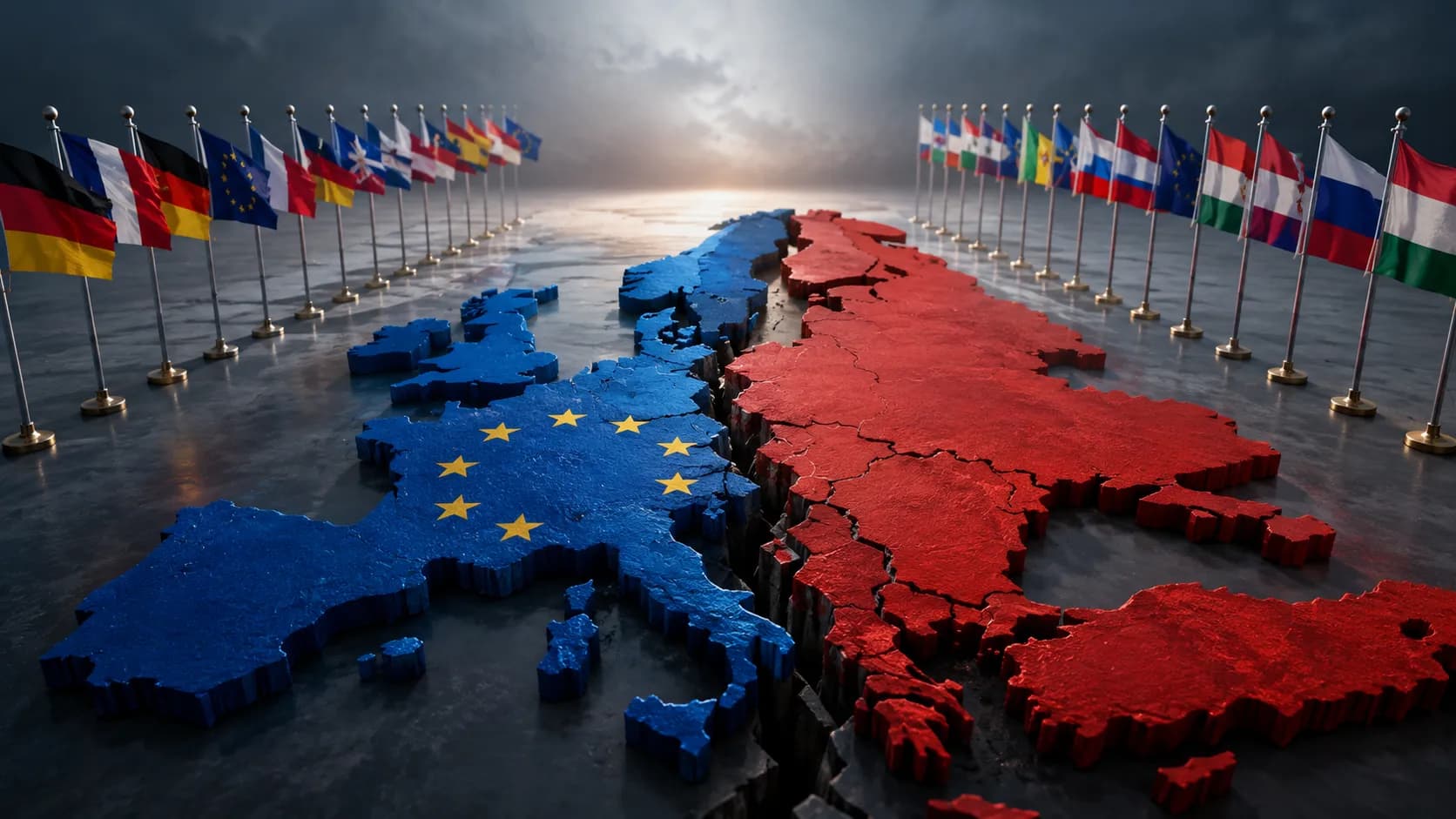
Europe is becoming more united against external threats while simultaneously growing more divided over how those threats should be managed.
Russia's war against Ukraine, irregular migration, defence spending, relations with the United States and disputes over the rule of law are producing overlapping political camps across the continent. Unlike the Cold War, today's European divisions do not follow a single East-West line. Different coalitions emerge depending on the issue.
By August 2026, these divisions have become increasingly visible inside both the European Union and NATO.
Ukraine Remains the Biggest Strategic Divide
The war in Ukraine continues to create Europe's most important geopolitical fault line.
Poland, the Baltic states and several Northern European countries generally support maintaining strong military and political pressure on Russia and regard Ukraine's security as directly connected to their own national security.
Countries geographically closer to Russia have also become some of Europe's most ambitious defence spenders. This reflects a perception in Eastern and Northern Europe that the Russian threat is immediate rather than theoretical.
But Central Europe has become considerably more complicated.
The traditional Visegrad Group is increasingly divided. Hungary and Slovakia have repeatedly challenged elements of the European consensus on Russia and Ukraine, while Poland has maintained a substantially harder security position toward Moscow. Political changes in the Czech Republic have further complicated the alignment of the region.
The result is an unusual situation: Central European countries that once cooperated closely on many EU issues are increasingly separated by their approaches to Russia and Ukraine.
Defence Creates Another Europe
A second division concerns how much Europe should spend on its own security.
EU defence expenditure reached approximately €418 billion in 2025 and is projected to increase to €454 billion in 2026. Twenty-three EU member states spent at least 2% of GDP on defence in 2025.
But national priorities remain very different.
Poland and countries close to Russia increasingly view rapid military expansion as unavoidable. Other European governments face stronger domestic pressure to balance defence expenditure against welfare systems, infrastructure and fiscal constraints.
This creates a growing distinction between Europe's "front-line states" and countries geographically further from Russia.
The debate is becoming even more important as Washington pressures Europeans to assume greater responsibility for continental defence. On August 27, a senior Pentagon official told NATO allies that the United States wants Europe to take a larger leadership role in defending the continent. Washington is simultaneously reviewing its military deployments in Europe.
Europe therefore faces a strategic question: should it remain primarily dependent on American military power or develop a substantially more autonomous European defence capacity?
Migration Divides North, South and East
Migration represents another major fault line.
The July migration crisis in Ceuta exposed how quickly solidarity between EU governments can weaken when national migration policies are involved.
Twenty-two EU leaders, predominantly from governments taking harder positions on migration, criticised Spain's approach following the crisis. France, Portugal and Luxembourg were among the countries that did not join the criticism. Madrid rejected the accusations.
This dispute illustrates a broader European transformation.
Italy, Denmark, Germany, Poland, Hungary and other governments with very different political traditions increasingly support stronger external-border controls and tougher measures against irregular migration.
At the same time, disagreements continue over asylum responsibilities, relocation, returns and cooperation with third countries.
Migration pressure is also affecting Schengen.
Germany, Austria, Italy, the Netherlands and other countries currently maintain temporary controls on some internal borders for reasons including irregular migration, security concerns and migrant smuggling. Italy and Spain have also introduced temporary controls following developments connected to Ceuta.
The political paradox is clear: Europe wants stronger common borders, but national governments increasingly resort to national border controls when they believe European mechanisms are insufficient.
Sovereignty Versus Deeper Integration
Behind many of these disputes lies an older argument about what the European Union should ultimately become.
One camp sees Europe's geopolitical challenges as evidence that deeper integration is necessary.
From this perspective, individual European states are increasingly too small to compete independently with the United States, China and other major powers. Europe therefore needs stronger common institutions in defence, technology, energy, industrial policy and foreign affairs.
Another political current emphasizes national sovereignty.
Hungary has been the most prominent example of this approach, particularly through disputes with Brussels over EU authority, judicial questions, migration and foreign policy.
These disagreements are not simply technical disputes.
They concern whether political authority should increasingly move toward Brussels or remain primarily with national governments.
Rule of Law Remains an Internal Fault Line
Questions concerning democracy, judicial independence, media freedom and institutional checks and balances continue to generate tension between Brussels and individual governments.
The European Commission's 2026 Rule of Law Report examines developments across all EU member states in four main areas: justice systems, anti-corruption frameworks, media freedom and pluralism, and institutional checks and balances.
Hungary has historically been at the centre of this confrontation, including disputes concerning EU funding and European rule-of-law requirements.
These conflicts have created a broader debate over whether EU institutions should financially penalise governments accused of violating common European standards or whether such mechanisms give Brussels excessive influence over domestic politics.
The United States Is Becoming Another Dividing Question
European attitudes toward Washington are also changing.
The debate is no longer simply whether Europe supports NATO. Most European governments continue to regard the alliance as essential.
The more difficult question is how dependent Europe should remain on the United States.
Washington's review of its military presence has increased pressure on European capitals to consider a future in which American forces play a smaller role in continental security. Around 80,000 U.S. troops are currently stationed in Europe, according to Reuters.
France has traditionally promoted greater European "strategic autonomy," while countries closer to Russia have often placed greater emphasis on maintaining a strong direct American military commitment.
The difference reflects geography as much as ideology.
For states facing Russia directly, American military power represents immediate deterrence. For supporters of strategic autonomy, excessive dependence on Washington represents a long-term vulnerability.
Europe Is Not Dividing Into Two Camps
The most important feature of Europe's current polarization is that there are no longer simply two permanent blocs.
Poland may disagree with Hungary over Ukraine while sharing tougher positions on migration.
France may support stronger European defence autonomy while remaining more cautious than Eastern European governments about some security priorities.
Italy can advocate restrictive migration policies while remaining integrated into broader European cooperation.
Nordic and Baltic countries can support deeper European security cooperation while simultaneously insisting on a powerful NATO relationship with Washington.
Europe's political map therefore changes depending on the issue.
The continent is increasingly divided along several overlapping lines: Russia versus accommodation, Atlanticism versus strategic autonomy, migration control versus humanitarian responsibility, national sovereignty versus deeper integration, and higher defence spending versus domestic economic priorities.
These divisions do not necessarily mean that Europe is breaking apart. In some areas, particularly defence, European cooperation is actually expanding rapidly.
But they reveal something more fundamental.
The European political debate is increasingly shifting from whether countries should cooperate to what kind of Europe they want to build — a more integrated geopolitical power, a union dominated by sovereign nation states, or a flexible system somewhere between the two.
That argument is likely to define European politics well beyond 2026.
Ahmet Balakan
Contributing writer at EUReflect.
Follow EUReflect
See more of our reporting on Google
Mark EUReflect as a preferred source and our stories are ranked higher for you in Top Stories, Discover and Google News — and carry a “preferred” badge when they are cited in AI results.
Add EUReflect as a preferred source