A Continent in Crisis: Is Europe’s Political Failure Fueling a Generational Uprising?
Youth unemployment at 22.2 per cent in France and inflation back at 3.8 per cent across the euro area form the backdrop to a protest wave that is urban, youth-led and anchored in schools and universities rather than the roundabouts of 2018.
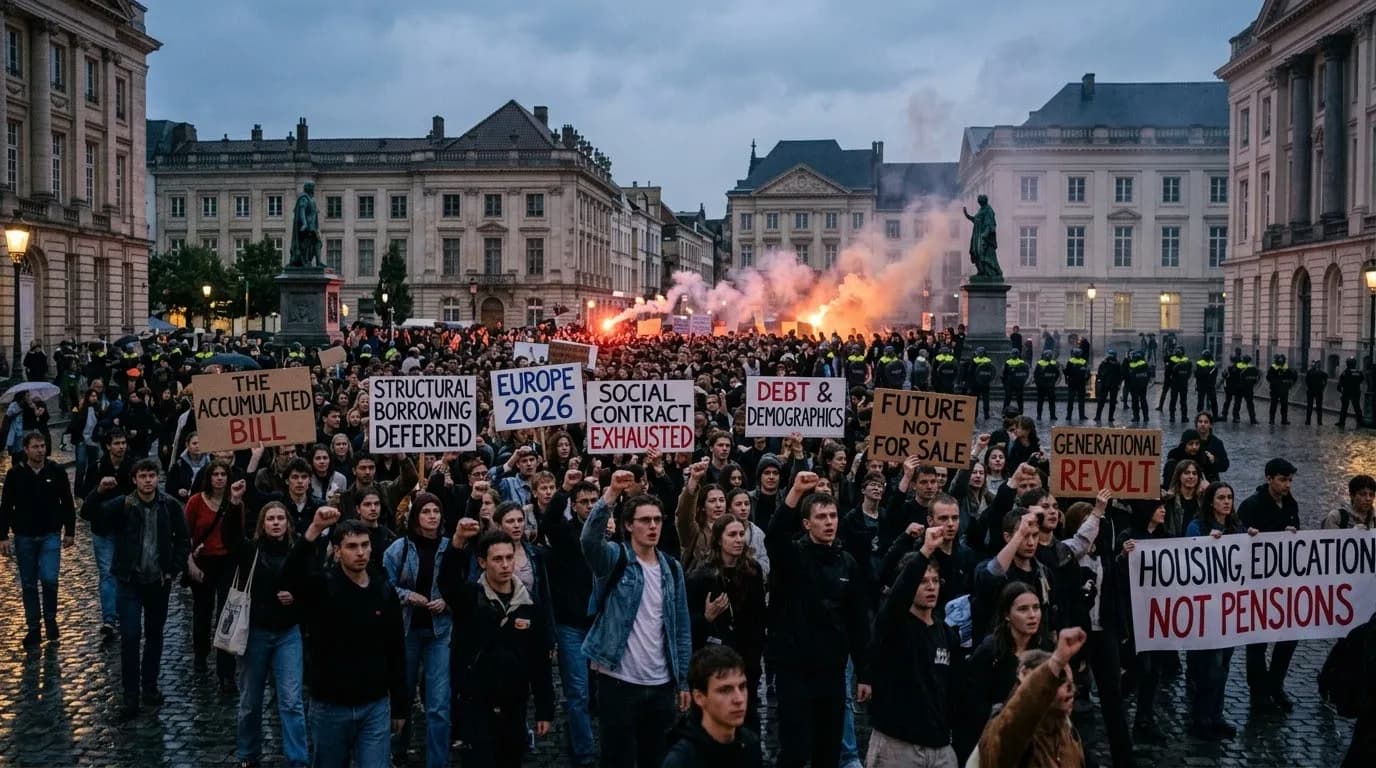
Europe's October 2026 protest wave did not erupt overnight. It is the accumulated bill for three decades of structural borrowing, fiscal, demographic and political, that governments across the continent have deferred rather than settled.
The economic backdrop
The economic backdrop is grim. Euro area inflation rebounded to 3.8 per cent in September, with energy prices up 18.9 per cent year on year. France's public debt is projected to reach 119.3 per cent of GDP this year, rising to 121.7 per cent in 2027, while youth unemployment stands at 22.2 per cent. These figures are symptoms rather than causes. The deeper driver is a postwar social contract that is fiscally exhausted, generationally inverted and politically unowned. Young people have moved from the margins of climate strikes to the core of a broader social revolt because the system they are being asked to inherit no longer adds up.
The scale is significant. France's interior ministry counted roughly 550,000 demonstrators nationwide on October 17, with 997 police officers and gendarmes injured and 2,397 arrests. In Milan, hundreds of black clad demonstrators clashed with police at Piazza del Duomo; at least four officers and twenty protesters were injured. In Lisbon, tens of thousands demanded affordable housing, pitching tents in the central square and calling for bans on what they termed vulture real estate funds.
A different protest movement
Crucially, the composition of this wave differs from the Yellow Vests of 2018 and 2019. That movement was rooted in peri urban and rural working age France and focused on fuel taxes and purchasing power. The October 2026 wave is urban, youth led and institutionally anchored in schools, universities and public squares rather than roundabouts. In France, high school students began protesting in September over teacher shortages, overcrowded classes and education budget cuts. By October, students, unions, farmers and climate activists had converged, though the youth contingent remained the shock troops. In Belgium, schoolchildren rioted in Brussels and Liège, prompting police to deploy water cannons and tear gas. In Spain, the eviction of an 87 year old woman after a 230 per cent rent increase triggered weeks of protests and tent camps in Madrid and Barcelona. In Portugal, one slogan captured the generational condition precisely: I want to move out from my parents before I am 50.
The common thread is not a single policy demand but a shared perception that the institutions supposed to secure a future for those under thirty are either unable or unwilling to do so.
Three structural failures
Three structural failures explain how Europe arrived here. First, debt financed welfare reached its limit. France has financed its social model through borrowing since the 1980s, with debt to GDP rising from roughly 30 per cent in 1980 to nearly 120 per cent today. That worked during the low interest rate era; it does not work when rates rise and growth stalls. Interest payments now crowd out precisely the public investments in education, housing and youth employment support on which young people depend. Niek Pas of the University of Amsterdam noted that the French protests erupted as the government faced severe fiscal and economic constraints, reflecting deeper structural problems in France's governance.
Second, the welfare state's generational distribution is inverted. Europe's postwar welfare systems were built on a demographic pyramid: many working age contributors supporting few retirees. That pyramid has reversed, but retirement ages and pension entitlements have adjusted far more slowly than demographics. The result is a public budget in which an ever larger share flows to the elderly while education, housing and childcare, the domains most critical to young adults, face relative retrenchment. Eszter Sandor of Eurofound warned that the benefits of macroeconomic stability are failing to reach the bottom half of the income distribution, with unemployed people, low paid workers and people with disabilities reporting the lowest trust in national governments and legal systems.
Third, post 2008 austerity imposed cumulative penalties on the young. Youth unemployment in southern Europe exceeded 50 per cent at its peak, and France's has remained structurally above 20 per cent for years. The pandemic recovery lowered headline unemployment but benefited young people less. Then the 2022 to 2026 energy and inflation shock hit renters and asset poor young adults asymmetrically. When a generation experiences three consecutive crises and each recovery prioritises existing stakeholders over future ones, street politics shifts from one option among many to the only option perceived as available.
Three possible trajectories
Three trajectories now present themselves. The first is managed decline: governments offer marginal concessions, rely on policing to contain violence and hope the anger subsides, while the protests recur with greater intensity as fiscal pressure mounts. France's debt trajectory forces either politically unthinkable default or ECB intervention that socialises French debt, deepening northern European resentment and fuelling populist backlash. This is the default path, and it satisfies no one.
The second is political rupture. France's 2027 presidential election becomes a referendum on the social model, with anti system candidates gaining on both flanks. Italy's government faces pressure from a militant labour movement and fiscal constraints simultaneously. The risk is not merely a change of government but a breakdown of the consensus anchoring European integration.
The third is a new social contract, the most desirable but least likely outcome. It would require acknowledging that the postwar settlement is obsolete: raising retirement ages in exchange for massive public investment in housing, education and childcare; reforming tax systems to capture wealth more effectively; and pooling fiscal sovereignty at the European level to manage debt collectively. The political capital for such a project does not currently exist. But the protests are a warning that the cost of inaction will eventually exceed the cost of reform.
A symptom, not a storm
The October 2026 protests are not a storm to be weathered. They are a symptom of a European social model that has reached its fiscal and demographic limits, and a political class that has failed to level with citizens about the choices ahead. The young people on the barricades are not simply demanding more money. They are questioning whether the system their parents built will ever work for them. Governments can arrest protesters and condemn violence, or they can treat the unrest as a summons to renegotiate the social contract. The first path leads to recurring crises and the slow erosion of democratic legitimacy. The second is difficult and politically costly, but it is the only one that offers a future worth the name.
Related Topics
Uroosa Khan
Contributing writer at EUReflect.
Follow EUReflect
See more of our reporting on Google
Mark EUReflect as a preferred source and our stories are ranked higher for you in Top Stories, Discover and Google News — and carry a “preferred” badge when they are cited in AI results.
Add EUReflect as a preferred source