Can Artificial Intelligence Really Unlock Trillions in Value, or Is It Just Hype?
Surveys show 96% of IT leaders have embedded AI in core processes and 88% of organisations use it in at least one function. Yet only 7% have scaled it across operations, leaving most gains confined to isolated pilots.
Is artificial intelligence truly the greatest wealth creation opportunity of our lifetime, or are we all just chasing an overhyped mirage?. Hence, artificial intelligence and machine learning are reshaping the global business landscape at an extraordinary pace, moving far beyond experimental prototypes to become essential drivers of efficiency, cost reduction, and revenue growth. According to the Cloudera 2025 global report, 96 percent of IT leaders have now integrated AI into core business processes, a significant jump from 88 percent the previous year, signaling a clear shift from pilot projects to full scale integration. McKinsey’s global survey reinforces this trend, finding that 88 percent of organizations now regularly use AI in at least one business function, up from 78 percent in 2024. This rapid adoption is fueled by the immense economic potential that AI promises. PwC projects that by 2030, artificial intelligence could contribute up to 15.7 trillion dollars to global GDP, representing a 14 percent increase over 2016 levels. Meanwhile, the machine learning market alone is expected to grow from 85 billion dollars in 2025 to over 1.08 trillion dollars by 2034, at a compound annual growth rate of 32.7 percent. These figures make it abundantly clear that AI and machine learning are no longer optional luxuries but fundamental determinants of competitive advantage in the modern economy.
Productivity gains across industries
The impact on productivity is one of the most visible and immediate benefits that businesses are experiencing worldwide. A comprehensive survey conducted by IBM and Censuswide across 3,500 executives in Europe, the Middle East, and Africa revealed that 66 percent of respondents had already observed substantial productivity gains from their AI deployments. Among those reporting improvements, 41 percent anticipated a full return on their AI investment within just one year. When broken down by business function, software development and IT, along with customer service, each accounted for 32 percent of the productivity gains, making them the leading areas of impact, while procurement followed closely at 27 percent. However, the Boston Consulting Group highlights that strategic clarity is critical to realizing these benefits. Companies with a clearly defined AI strategy achieved 80 percent measurable business impact, whereas those that merely accumulated AI tools without a coherent plan achieved only 60 percent. Despite these encouraging numbers, McKinsey notes that only 7 percent of organizations have fully scaled AI across their operations, indicating that the transition from isolated efficiency gains to enterprise wide transformation remains a major hurdle for most businesses.
Different industries are harnessing AI and machine learning in unique ways, each reaping distinct rewards that reflect their specific operational challenges and customer needs. In the retail sector, AI powered demand forecasting and personalized marketing are generating remarkable returns. A supermarket chain in California used AI to optimize promotional campaigns, generating an additional 1 million dollars in revenue per campaign. Research from Symphony AI indicates that retailers can achieve sales growth between 3.5 and 4.8 percent through intelligent AI applications. Even at the grassroots level, technology startups like Packworks in the Philippines are helping small community stores analyze transaction data to refine product assortments and inventory replenishment, resulting in a 46 percent increase in daily gross merchandise value and a 17 percent boost in total sales. These examples demonstrate that AI’s value is not confined to large enterprises; small and medium sized businesses can also unlock significant gains when the technology is applied to the right use cases.
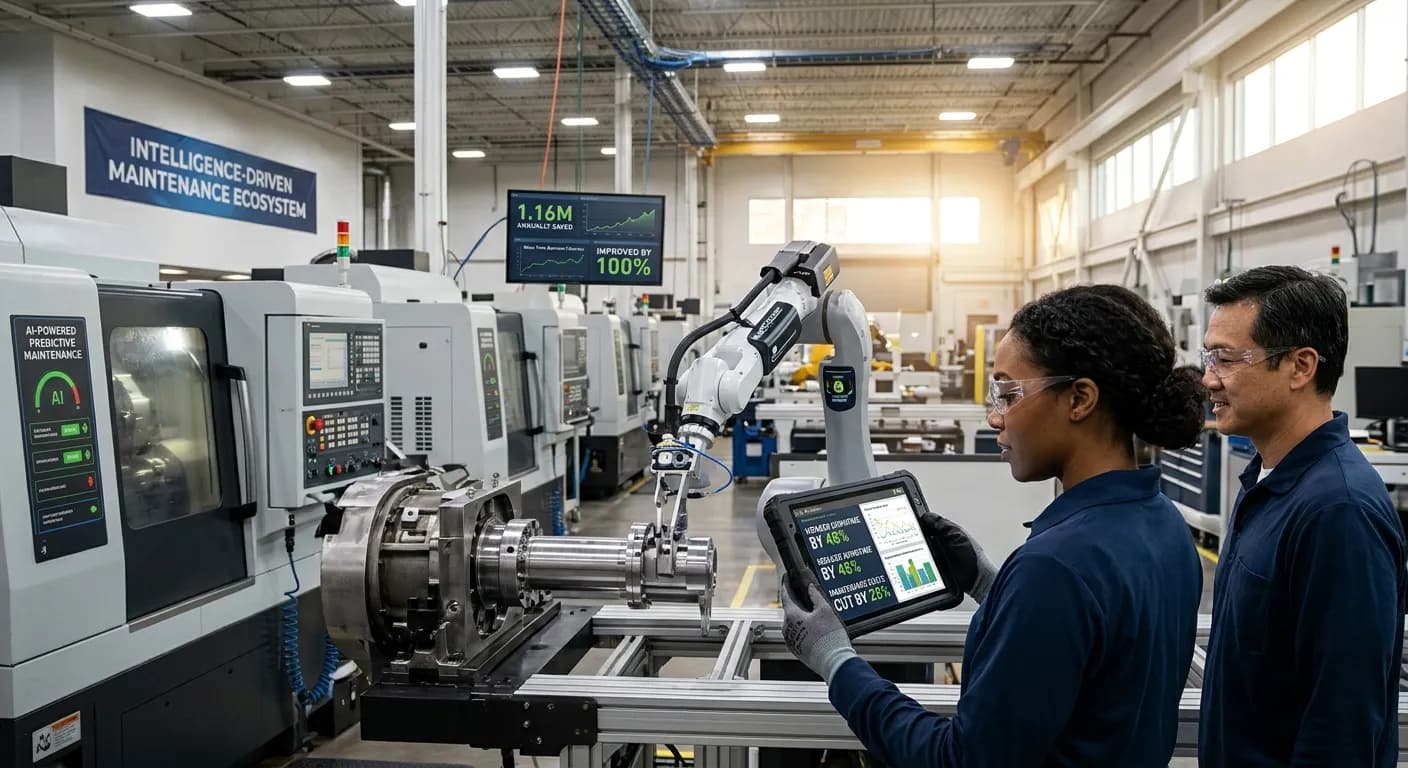
Manufacturing is another sector where AI and machine learning are driving profound operational improvements, particularly through predictive maintenance. Advanced algorithms can detect early warning signs of equipment failure, drastically reducing unplanned downtime. Industry studies show that AI driven predictive maintenance can lower downtime by 30 to 50 percent and cut maintenance costs by 20 to 30 percent. A midwestern manufacturing plant saved 40 million dollars annually by allowing an algorithm to predict equipment breakdowns before they occurred. More rigorous empirical research has documented even more impressive outcomes, with one study showing that predictive maintenance systems using causal inference models achieved annual cost savings of 1.16 million dollars, equivalent to a 70.2 percent reduction in maintenance expenditures. Another analysis reported that AI implementation in manufacturing improved mean time between failures by 100 percent, reduced mean time to repair by 67 percent, lowered maintenance costs by 37.5 percent, and cut unplanned downtime expenses by 71.4 percent. These statistics underscore that machine learning is fundamentally transforming manufacturing from a reactive repair culture to a proactive, intelligence driven maintenance ecosystem.
In the financial services industry, AI and machine learning have proven exceptionally effective in enhancing both risk management and operational efficiency. A European bank leveraged AI to reduce compliance false positives by 77 percent while simultaneously boosting fraud detection capabilities by 160 percent. Compared to traditional rules based systems, AI powered fraud detection can lower false positive rates by as much as 40 percent and increase detection speed by 25 percent. In cross border payments, a Swift led experiment demonstrated that collaborative AI models combined with privacy enhancing technologies delivered twice the real time effectiveness of conventional methods when processing 10 million simulated transactions. The financial sector overall shows above average readiness for AI adoption, particularly in risk and compliance functions, though opportunities remain for greater cross industry collaboration and value chain reinvention. These cases illustrate how machine learning is helping financial institutions strike a better balance between rigorous risk control and seamless customer experience.
Widening gap between leaders and laggards
Nevertheless, the benefits of AI and machine learning are not distributed evenly across the corporate world, and the gap between leaders and laggards is widening. PwC’s research reveals a striking concentration of value, with 74 percent of all AI driven economic gains captured by just 20 percent of organizations. These leading companies are not simply deploying more AI tools; they are treating AI as a catalyst for growth and business reinvention, actively pursuing new revenue streams while building robust foundations around data governance, security, and trust. They are also significantly more likely than their peers to use AI to identify and seize growth opportunities arising from industry convergence. McKinsey’s findings echo this disparity, noting that only 39 percent of organizations report measurable EBIT level impact from AI, and only about 6 percent of high performers attribute more than 5 percent of their EBIT to AI. These high performers are also much more inclined to pursue transformative business changes in the next three years. This polarization serves as a powerful reminder that competitive advantage from AI is not automatic; it depends on deliberate strategic choices, organizational alignment, and execution excellence.
AI agents in customer service
Customer service has emerged as a frontline domain where AI agents are redefining how businesses interact with their clients. Salesforce research indicates that adoption of AI service agents has surged from 39 percent in 2025 to 66 percent in 2026, with 70 percent of service organizations that deployed these agents observing measurable business value within just 60 days. Currently, 40 percent of customer service cases are handled entirely by AI without human intervention, and average case resolution times have dropped by 20 percent. Service professionals expect that AI tools will ultimately lead to a 20 percent reduction in service costs and a 20 percent improvement in customer satisfaction scores. More broadly, Boston Consulting Group reports that frontline employee usage of AI on a regular basis jumped from 51 percent in 2025 to 74 percent in 2026, while the share of organizations integrating AI agents directly into workflows doubled from 13 percent to 30 percent. These trends signal that AI is migrating from back office support to the center of customer facing operations, evolving from a passive assistant into an active participant in core business processes.
Future outlook for global commerce
Looking toward the future, the influence of AI and machine learning on global commerce is only in its early stages, with much greater disruption and value creation on the horizon. The machine learning market is projected to sustain a compound annual growth rate exceeding 30 percent over the next decade. In supply chain management, over 80 percent of supply chain leaders plan to deploy AI applications by 2025, targeting areas such as demand sensing, inventory optimization, and logistics routing. From a strategic perspective, 62 percent of executives rank multi agent systems as their top priority for future AI deployment, while 60 percent are enthusiastic about reinforcement learning’s potential to solve complex dynamic problems. Yet, significant obstacles remain. Data integration and accessibility continue to be primary barriers, with only 9 percent of businesses reporting that all their data is fully ready for AI consumption. Half of all organizations lack a formal AI governance framework, and 66 percent of frontline employees say they receive little guidance on how to best utilize the time saved through AI automation. These gaps highlight a crucial lesson: the business value of AI depends not solely on technological sophistication but equally on systematic investments in data quality, workforce upskilling, governance structures, and process redesign.
Thus, artificial intelligence and machine learning are fundamentally transforming how businesses operate across the globe, touching every sector from retail and manufacturing to finance and customer service. The macroeconomic projections of trillions of dollars in GDP contribution, the microeconomic evidence of double digit productivity gains, and the industry specific successes in predictive maintenance, fraud detection, and personalized marketing all attest to AI’s immense potential. However, the journey from technology adoption to tangible value creation is neither linear nor guaranteed. The stark disparity between top performers and the rest of the field underscores that strategic vision, robust data governance, and a culture of continuous innovation are just as important as the algorithms themselves. As AI technologies continue to evolve at breakneck speed, the companies that will thrive are those that move beyond using AI merely as a tool for incremental efficiency and instead embrace it as a cornerstone of business reinvention. The era of AI driven commerce is already upon us, and its full potential is only just beginning to unfold, promising a future where intelligence, both artificial and human, works in concert to redefine what is possible in business.
Uroosa Khan
Contributing writer at EUReflect.
Follow EUReflect
See more of our reporting on Google
Mark EUReflect as a preferred source and our stories are ranked higher for you in Top Stories, Discover and Google News — and carry a “preferred” badge when they are cited in AI results.
Add EUReflect as a preferred source