Dubai airport traffic still 28 per cent down as European airlines return
Dubai International handled 50.4 million passengers in the first nine months of 2026, 28 per cent fewer than a year earlier, and expects just over 70 million for the full year. British Airways is back and Lufthansa returns on 25 November, restoring direct European capacity before Dubai's busy winter months.
Dubai International (DXB) is handling just under three-quarters of last year's traffic, and the gap is narrowing as Europe's airlines come back. Dubai Airports, the state-owned operator, said on Tuesday 17 November that 50.4 million passengers used the airport between January and September, a fall of 28.1 per cent on the same months of 2025.
The operator's chief executive, Paul Griffiths, now forecasts "more than 70 million guests this year". In 2025 DXB handled a record 95.2 million, which the operator describes as the highest annual international traffic any airport has recorded. Before the Iran war, numbers had been expected to come close to 100 million in 2026, Gulf News noted; that target has now moved to 2027, according to The National.
The war, which began with US-Israeli strikes on Iran on 28 February, hit the spring hardest. Gulf News put second-quarter traffic at about 13 million, with monthly numbers rising from 3.5 million in April to 5 million in June. The summer was stronger: 18.8 million passengers passed through between July and September, 22.1 per cent below a year earlier, and August was the peak month at 6.6 million.
Europe's carriers fill the gaps
DXB now has 57 airlines serving 235 destinations in 101 countries. In the first half of the year it had almost 50 airlines and 217 destinations. British Airways resumed Heathrow flights this month after an eight-month break, and Royal Air Maroc, Cebu Pacific and SunExpress, have also returned. Lufthansa Group said last week it would restart Dubai services on 25 November, The National reported. Dubai Airports says more airlines will come back in the coming weeks but has not named them.
The timing matters for European tour operators and hotel investors. In September, 49 per cent of DXB's passengers were starting or ending their trip in Dubai and 51 per cent were connecting; the operator says the local share usually rises in winter, when the city's events calendar pulls in more visitors. Western Europe was Dubai's largest source of visitors from January to August, at 20 per cent, ahead of South Asia at 17 per cent and Gulf states at 16 per cent, The National reported in September.
Hotels are recovering from a deep trough. According to the same Dubai government figures, the city drew 869,000 international overnight visitors in August, its best month since the war began, and hotel occupancy reached 66 per cent, against a citywide average of 36 per cent in March. The 6.97 million international visitors from January to August compare with 19.59 million for the whole of 2025.
Griffiths told reporters the airport's capacity was about "83 per cent" back, and that airline recovery rates, Emirates' in particular, were "in the 90s" per cent. "We may even see close to our magic 100 million by the end of next year," he said.
Optimism meets a live conflict
He said he did not expect the attacks on neighbouring Saudi Arabia and Bahrain to spill over into demand for Dubai, and spoke of a "sense of optimism" that a diplomatic solution was now more likely than a military one.
The security picture has not settled. On Wednesday 18 November Kuwait said its air defences were responding to drone attacks and Bahrain said it had intercepted strikes from Iran, following a US strike on Qeshm Island in Iran the previous day, according to Gulf News' live coverage. Short-haul links to Saudi Arabia are still being cut: Etihad has extended its Abu Dhabi cancellations to Dammam and Riyadh until 30 November, and flydubai will not fly to Riyadh or Abha before 27 November, running only a reduced schedule to Dammam.
What the numbers say about demand
India remained the largest country market in the third quarter with 2.6 million passengers, followed by Saudi Arabia (1.4 million) and the United Kingdom (1.3 million). London was the top city link at 784,000 passengers. Germany, at 480,000, was the only other European country among the six largest markets the operator listed. Of the leisure destinations it highlighted, Milan grew 20 per cent and Barcelona 13 per cent.
Freight, a gauge of trade through the hub, fell 23.2 per cent to 1.215 million tonnes over the nine months. Aircraft movements dropped 27.6 per cent to 243,000, and the average load factor slipped three points to 74 per cent.
Dubai is also pressing on with its replacement airport. Griffiths said Al Maktoum International (DWC), a $35bn project whose first phase is due to open in 2032, will need at least a year of testing before passengers arrive, The National reported. Dubai Airports has awarded Dh13bn ($3.53bn) of terminal contracts this year and expects contract awards to reach Dh55bn by the end of 2026, Griffiths said in August, according to the same report. Until DWC opens, the operator is relying on artificial intelligence, predictive analytics and biometric checks to move more people through DXB "without expanding the airport's footprint".
Related on EUReflect: Arabian Travel Market 2026: Dubai positions tourism as a platform for international cooperation · Tourism's new currency is confidence
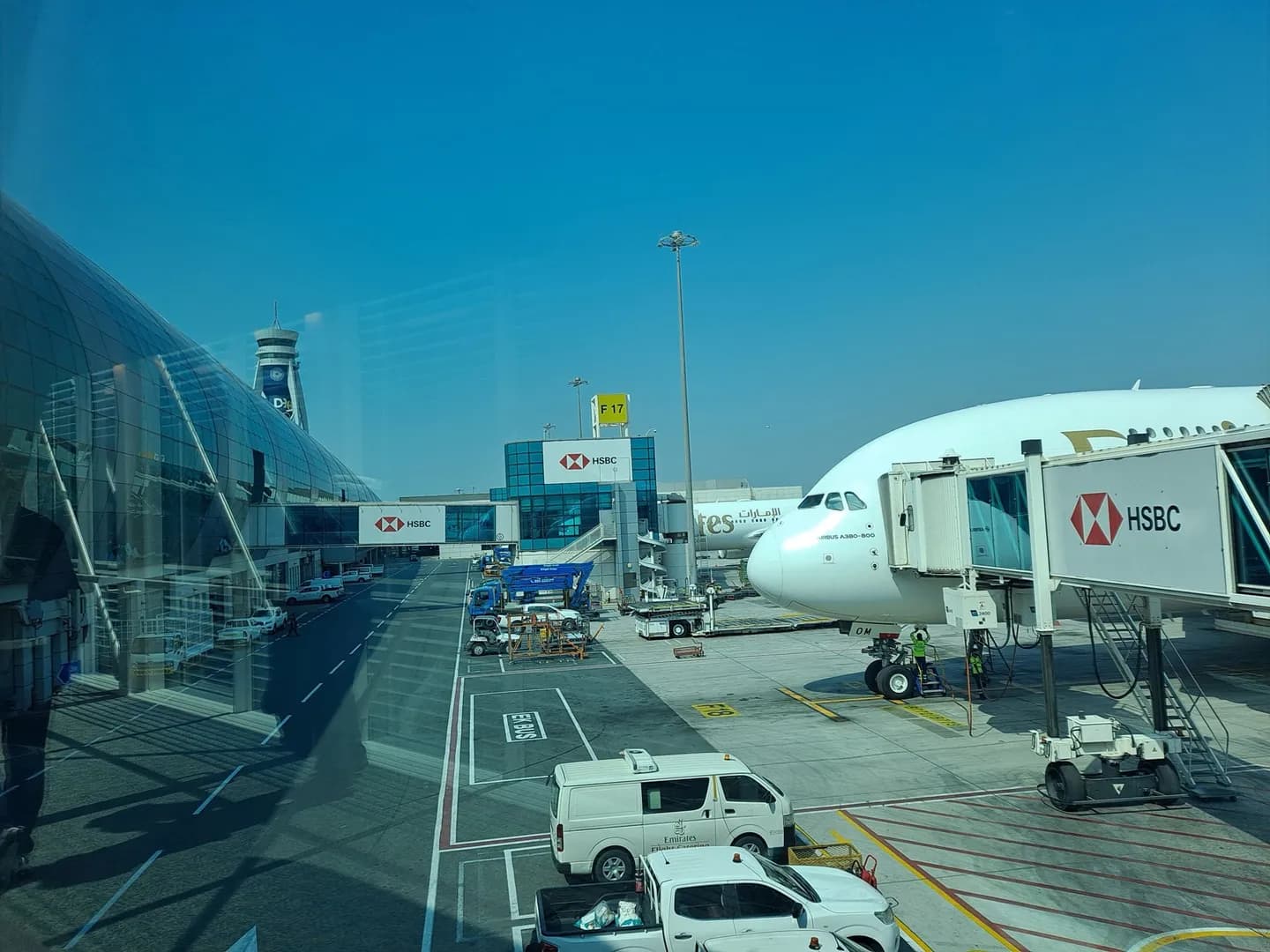
Main image: An Emirates A380 at Terminal 3 of Dubai International Airport, which handled 50.4 million passengers in the first nine months of 2026. Photo: EditQ / Wikimedia Commons, CC0.
Related Topics
EUReflect News
Site Administrator
Follow EUReflect
See more of our reporting on Google
Mark EUReflect as a preferred source and our stories are ranked higher for you in Top Stories, Discover and Google News — and carry a “preferred” badge when they are cited in AI results.
Add EUReflect as a preferred source