Myanmar Moves Higher on Europe’s Indo-Pacific Agenda
Myanmar supplied 60% of global dysprosium and terbium in 2023, critical for EV motors and wind turbines, per industry analysts.
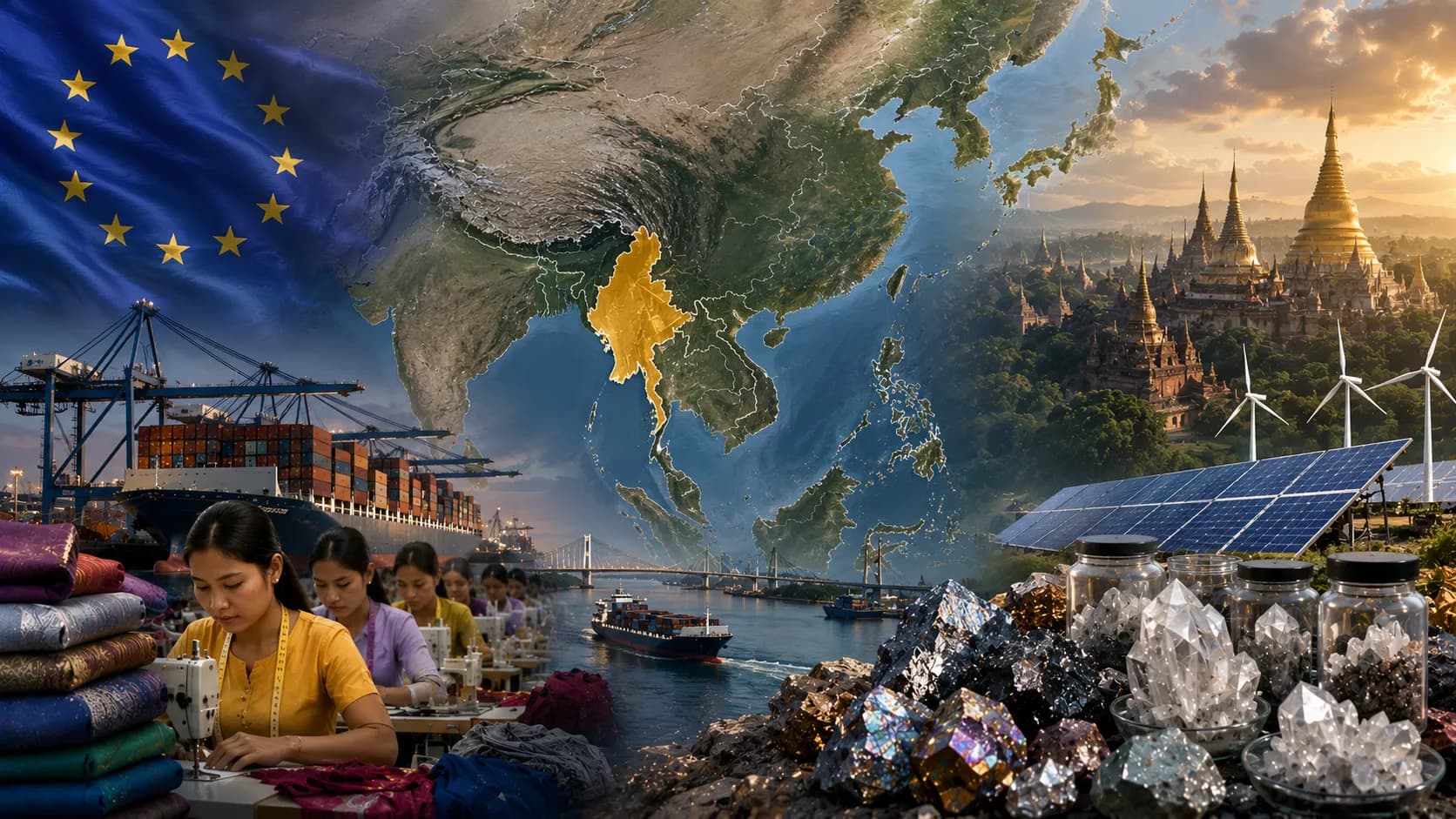
Positioned as a bridge between China and India and opening onto the Bay of Bengal, Myanmar is occupying an increasingly visible place in the European Union's vision for Asia. According to a March 2026 assessment by the International Crisis Group, the country sits in a subregion of central importance to the EU's Indo-Pacific strategy, and Brussels is advised to link its Myanmar policy with the Indo-Pacific strategy and its critical raw materials frameworks.
At the backbone of the economic relationship lies the "Everything But Arms" (EBA) arrangement, which grants least developed countries duty-free and quota-free access to the EU market. According to the European Commission's latest figures, published in May 2026, EU imports from Myanmar stood at 3 billion euros in 2025, with exports at 400 million euros; imports grew at an annual average rate of 7.7 per cent over the 2021-2025 period. It is emphasised that the EU-oriented garment sector sustains hundreds of thousands of jobs — held mostly by young women from poor households — and that the EU is the sector's largest export market: a picture that aligns directly with Europe's development and decent-work agenda.
Critical raw materials magnify strategic value
What truly magnifies the country's strategic value, however, is critical raw materials. According to an analysis based on International Energy Agency data, Myanmar ranked second in global rare earth production in 2024 with a 16 per cent share, behind only China's 61 per cent, and exported more than 28,000 tonnes of rare earths worth 624 million dollars in the first nine months of 2025. The picture is even more striking for dysprosium and terbium, indispensable to electric vehicle motors and wind turbines: in 2023, approximately 60 per cent of the global supply of these two heavy rare earth elements originated from Myanmar. Industry analysts note that Myanmar accounts for an estimated 50-70 per cent of global heavy rare earth supply outside China's quota system, while no Western-compliant direct supply chain yet exists — a structural reality that makes the country a long-term partner candidate for an EU accelerating its green transition and seeking to diversify its supply chains.
Myanmar integral to ASEAN and EU partnership
At the regional level, Myanmar is an integral part of ASEAN, which the EU defines as its "natural partner" in Southeast Asia. The current period, in which Naypyidaw has been accelerating its pursuit of regional normalisation through high-level visits extending to Thailand in August 2026, also provides ground for deepening Europe's institutional ties with the region.
Institutional contact channels likewise offer the ground on which this importance can be cultivated. The EU's on-the-ground presence through its delegation in Yangon, the regular technical contacts required by the EBA framework, and the ASEAN-EU partnership architecture provide Brussels with a multilayered infrastructure for institutional engagement with the country. The Crisis Group's report also lists intelligence sharing and asset tracing, alongside political and technical coordination with ASEAN and relevant member states, among the domains for cooperation; sustaining high-level political attention to the country ranks among the report's principal recommendations to Brussels.
Diplomatic observers weigh Myanmar's importance
According to diplomatic observers, Myanmar carries a weight in the EU's Indo-Pacific equation that cannot be underestimated — with a trade volume exceeding 3 billion euros, a young workforce, a decisive share of global heavy rare earth supply, its position within ASEAN, and its strategic geography. Brussels' translation of this multilayered importance into a coherent strategy in the coming period is regarded as a win-win opportunity capable of expanding Europe's regional visibility and the prosperity of Myanmar's people at the same time.
Botakoz Unbayeva
Contributing writer at EUReflect.
Follow EUReflect
See more of our reporting on Google
Mark EUReflect as a preferred source and our stories are ranked higher for you in Top Stories, Discover and Google News — and carry a “preferred” badge when they are cited in AI results.
Add EUReflect as a preferred source