Political Authority and The Principles of Shura in Islamic Governance: Ethical and Institutional Dimensions in the Perspective of Shinqiti
The principle of shura (consultation), one of the foundational conceptual elements of governance, emerges as an indispensable component of legitimate rule at both the theoretical and practical levels.
In Islamic political thought, the source and legitimacy of governing authority must be addressed with direct reference to the Qur’an and the practices of the Prophet Muhammad (S. A. W.). Within this framework, the principle of shura (consultation), one of the foundational conceptual elements of governance, emerges as an indispensable component of legitimate rule at both the theoretical and practical levels. The Qur’anic verse in Surah al-Shura (42:38) states, “Their affairs are conducted by mutual consultation among them,” clearly emphasizing that political decisions should be made through societal deliberation. This articulation privileges collective reasoning and public consent over individual arbitrariness, promoting a model of governance grounded in shared responsibility.[1]
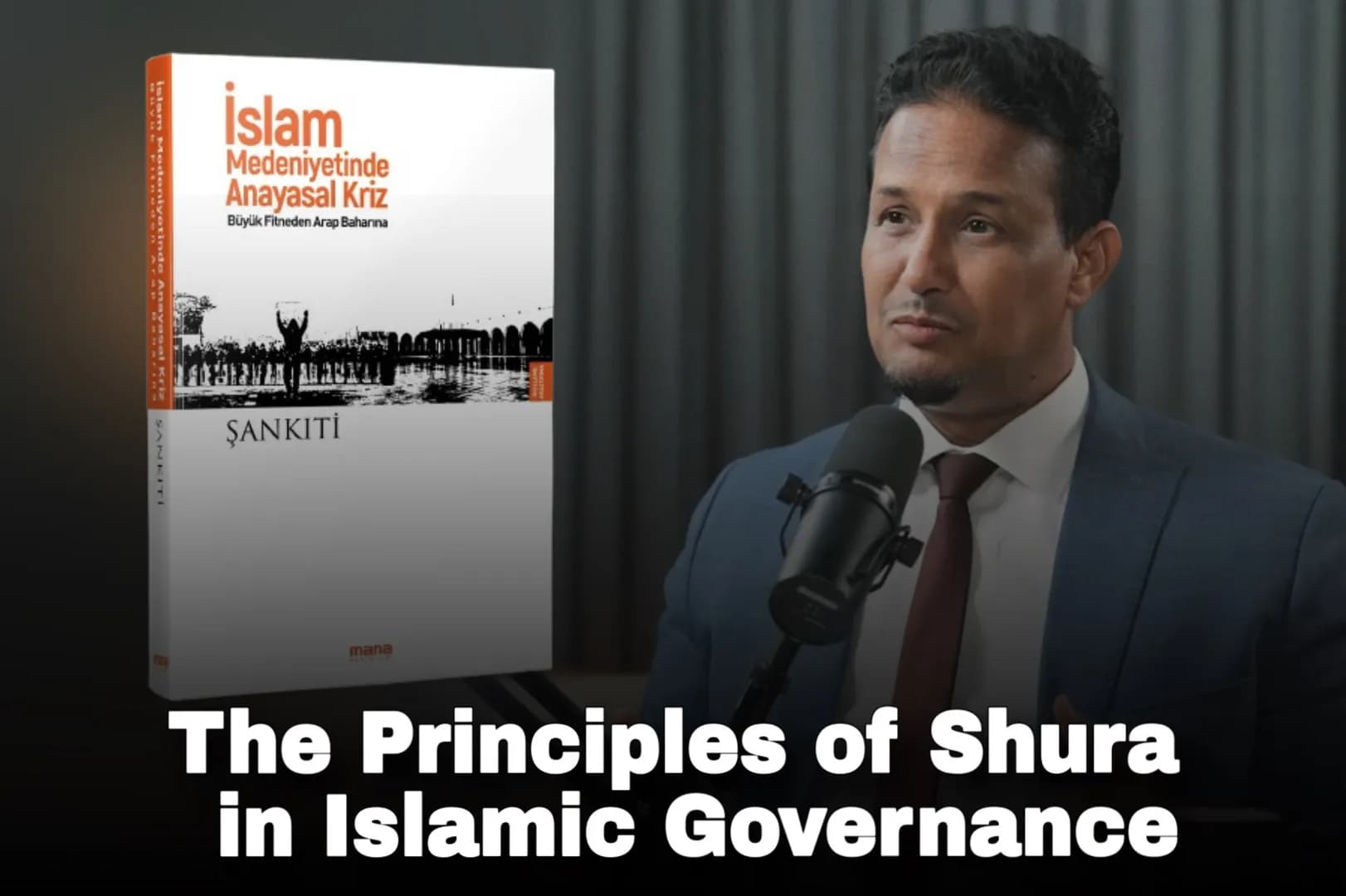
Among contemporary Islamic thinkers, Dr. Muhammad al-Mukhtar al-Shinqiti provides a profound analysis of the shura principle, interpreting it not merely as a procedural mechanism of governance but as a fundamental moral and political doctrine grounded in Islamic law (sharī‘a). According to al-Shinqiti, a government’s legitimacy is contingent upon its reliance on popular will and participatory consultation. For him, shura constitutes the backbone of Islamic political theory, around which the values of justice, legitimacy, and public interest are structured.
Al-Shinqiti conceptualizes shura as a two-dimensional system:
Moral Foundation: Governance rooted in justice and shaped through the participation of the populace is a moral imperative in Islam. A ruler, as one who bears divine accountability, cannot enact decisions without consulting the people. This transforms leadership from a divine privilege into a societal responsibility.
Practical Necessity: Sustainable political stability and social peace in modern societies can only be achieved through the effective functioning of shura. Public participation in governance is not only a right but also a stabilizing factor in the political structure.
To operationalize shura within the framework of political governance, three essential elements must be concurrently present:
First, individuals must possess the right to make free and informed choices. This ensures both the legitimacy of political participation and the appointment of leaders based on public consent. The ability of the people to express their preferences without coercion, manipulation, or fear is intrinsically linked to Islamic principles of justice and accountability. In the absence of free elections, shura becomes a mere formality, and legitimacy is fundamentally undermined.
Second, rulers should be elected in a manner that represents the broader society rather than serving the interests of a specific socio-economic or tribal group. This ensures inclusive decision-making processes. Political legitimacy must rest on broad social consensus, and authority should not become the privilege of a particular elite. Otherwise, the principle of shura risks deviation from justice and equality, potentially leading to discrimination and authoritarianism.
Third, elected leaders must be accountable to the people—that is, subject to public oversight and subject to removal when necessary. Shura is not limited to the moment of election; it encompasses ongoing mechanisms of accountability, consultation, and responsibility. From this perspective, granting rulers unchecked authority or allowing them to make decisions independently of the public contradicts the Islamic conception of governance. As al-Shinqiti emphasizes, a leader’s legitimacy stems from the public will, which is actualized not only through the right to vote but also through the right to monitor and, if needed, replace those in power.
Thus, the combination of free choice, social representation, and accountability transforms shura into a functional principle at both ethical and institutional levels, forming the legitimate basis of political authority in Islam.
Al-Shinqiti also highlights one of the most vivid historical instances of the shura principle: the period following the Prophet Muhammad’s death (S. A. W.). The Prophet Muhammad (S. A. W.) did not appoint a successor directly; instead, he left the decision to the community, thereby granting them the opportunity to determine their political future. The appointment of Abu Bakr as the first Caliph was the outcome of a process of consultation, underscoring that leadership authority in Islam is not divinely ordained but arises from collective decision-making.
The Prophet Muhammad’s (S. A. W.) statement supports this participatory approach:
“If you choose Abu Bakr, you will find him trustworthy and detached from worldly possessions, always preparing for the Hereafter. If you choose Umar, you will find him strong and reliable; he fears no blame in the cause of Allah. If you choose Ali—though I do not think you will—you will find him a guide and an exemplar who leads you to the truth.”
This remark illustrates that the community was encouraged to deliberate over various candidates rather than being bound by a predetermined succession. Al-Shinqiti interprets this event as a historical application of the shura principle and argues that any political system established without the participation of the community is inherently problematic in terms of legitimacy.
In conclusion, the principle of shura functions not only as a method for forming governments in Islamic political thought but also as a normative framework that defines the scope of authority and responsibility of rulers. Rooted in both Qur’anic guidance and Prophetic practice, shura embodies core values such as justice, participation, and accountability. Dr. al-Shinqiti’s interpretation reveals that shura is not merely a historical legacy but a dynamic model of governance that needs to be reconstructed at both theoretical and institutional levels in contemporary Muslim societies.
In this regard, shura represents a multidimensional framework that aligns with the normative teachings of Islam while simultaneously addressing the political and social needs of modern societies. Al-Shinqiti’s perspective compels a renewed discussion of shura in the face of legitimacy crises in today’s Muslim world and advocates its adoption as a foundational element of governance. Thus, shura is not only a legacy of just governance from the past but also a vital reference point for building participatory, just, and accountable political systems for the future.
[1] Şankıti, Muhammed Muhtâr, İslam Medeniyetinde Anayasal Kriz: Büyük Fitneden Arap Baharına (çev. Muhammet Çelik), İstanbul: Mana Yayınları, 2021.

İsmail Polat
Ph. D. in International Relations
Follow EUReflect
See more of our reporting on Google
Mark EUReflect as a preferred source and our stories are ranked higher for you in Top Stories, Discover and Google News — and carry a “preferred” badge when they are cited in AI results.
Add EUReflect as a preferred source