The Middle Corridor Rises: How Uzbekistan and Azerbaijan Are Rewiring Eurasia
President Shavkat Mirziyoyev’s state visit to Azerbaijan underscored Uzbekistan and Azerbaijan’s deepening strategic partnership and shared vision for a new Eurasian geo-economic landscape. Centered on the Middle Corridor, the talks highlighted growing trade, transport integration, and plans to export Uzbek “green” electricity to Europe—positioning both nations as pivotal hubs in Eurasian logistics, energy connectivity, and sustainable development.
Vazira Bazarova, Journalism and Mass Communications University of Uzbekistan
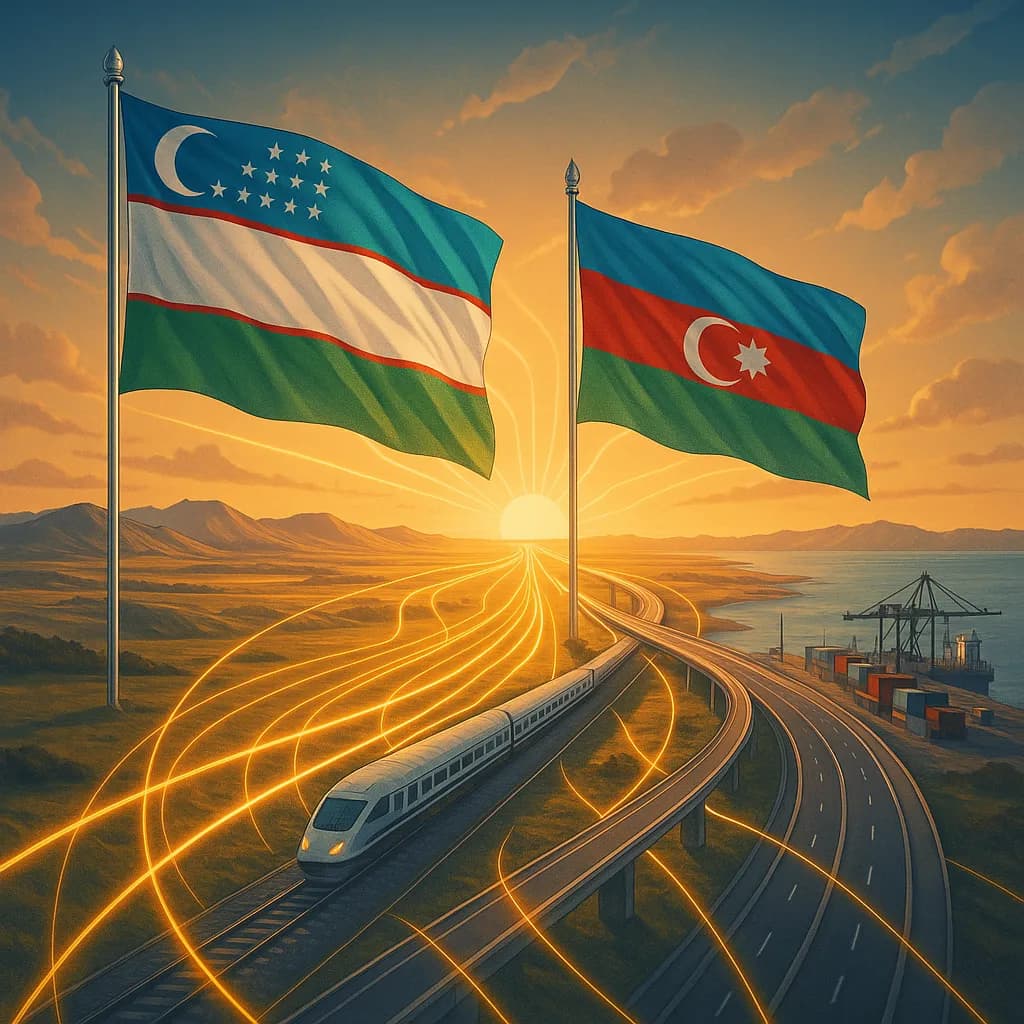
The state visit of President of Uzbekistan Shavkat Mirziyoyev to Azerbaijan vividly demonstrated the depth of strategic partnership between the two countries and their mutual commitment to shaping a new geo-economic reality in Eurasia. One of the central topics of the talks was the development of the Middle Corridor — an essential transport and logistics route connecting East and South Asia with Europe via the Caspian Sea, the South Caucasus, and Turkey.
The Middle Corridor has long ceased to be just a project; today, it is a functioning platform for expanding mutual trade, integrating transport networks, and advancing energy cooperation. The over 25% increase in Uzbek cargo traffic along this route, the launch of an electronic permit system, and strengthened coordination among relevant agencies are clear indicators that the Tashkent-Baku partnership is reaching a new level of institutional maturity.
Of particular importance is the discussion on exporting Uzbek “green” electricity to Europe. In the context of the global transition to a low-carbon economy, Uzbekistan’s participation in renewable energy supply positions it as a key player in the emerging energy map of Eurasia. The proposed joint energy project is not merely a commercial contract but a politico-economic signal: Tashkent and Baku are ready to serve as conduits for “green connectivity” between Asia and Europe.
It is worth emphasizing that the recent agreements are underpinned by a comprehensive strategy: both countries view transport and energy not as mere technical sectors but as tools to ensure long-term stability, sustainable growth, and enhanced regional agency. Against the backdrop of turbulence in the international system, Uzbekistan and Azerbaijan are consistently building precisely the kind of multi-vector interdependence that makes them less vulnerable to external pressure and simultaneously more integral to global supply chains.
Thus, the visit laid the foundation not only for a new investment program but also reaffirmed the strategic course toward transforming Tashkent and Baku into key links in Eurasian logistics. The Middle Corridor is no longer just a road — it is becoming a geopolitical artery through which a new architecture of cooperation is taking shape.
Author: Vazira Bazarova, Journalism and Mass Communications University of Uzbekistan
This article may be shared or referenced by third parties only with proper attribution. Please include a clear citation and a link to the original article on our website.
EUReflect News
Site Administrator
Follow EUReflect
See more of our reporting on Google
Mark EUReflect as a preferred source and our stories are ranked higher for you in Top Stories, Discover and Google News — and carry a “preferred” badge when they are cited in AI results.
Add EUReflect as a preferred source