AI Enters the Battlefield
The Pentagon's 2026 AI strategy and Palantir's Maven Smart System signal a shift toward software-defined warfare, with startups like Smack Technologies raising $61 million for AI decision-making tools.
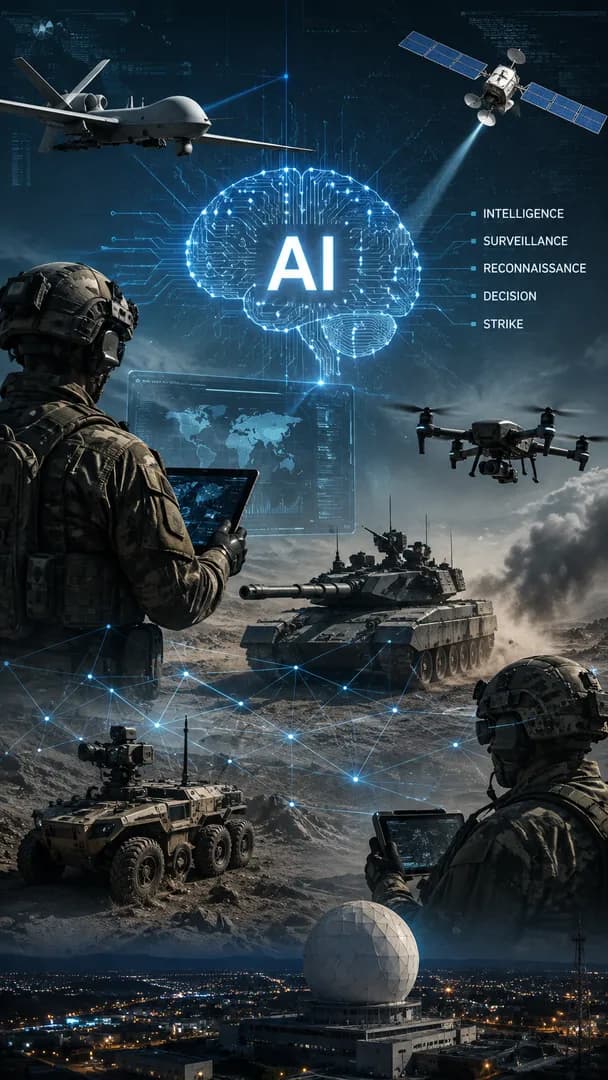
Artificial intelligence is rapidly moving from research laboratories into the core of modern defense systems. In 2026, the shift has become increasingly visible across the United States, NATO and the war in Ukraine, where AI is being integrated into drones, intelligence systems, battlefield decision-making, cyber defense and command-and-control networks.
The emerging competition is no longer simply about which military possesses the most advanced aircraft, missiles or armored vehicles. Increasingly, it is about which force can collect information, analyze it and make operational decisions faster.
The Pentagon Accelerates AI Adoption
The United States is at the center of this transformation.
The Pentagon's 2026 artificial intelligence strategy describes AI-enabled warfare and AI-supported capability development as technologies that could redefine military affairs over the next decade. The objective is not limited to developing autonomous weapons. Washington is seeking to integrate AI throughout military operations, from intelligence analysis and logistics to targeting support and battlefield planning.
One of the clearest signs of this shift came earlier this year when the Pentagon moved to make Palantir's Maven Smart System a core component of U.S. military operations. The system combines information from different sensors and intelligence sources and uses AI to help commanders understand battlefield developments and identify potential targets more rapidly.
The transformation is also creating a new generation of defense technology companies.
On August 17, Reuters reported that U.S. defense-tech company Smack Technologies had raised $61 million to expand AI-powered battlefield decision-making systems. Its Omega platform uses technologies including computer vision and reinforcement learning to accelerate military planning as battlefield conditions change.
The development illustrates a broader trend: software companies are becoming increasingly important players in an industry once dominated almost entirely by traditional defense manufacturers.
Ukraine Becomes a Testing Ground
The war in Ukraine has dramatically accelerated the military use of artificial intelligence and autonomous technologies.
Both sides have deployed drones on an enormous scale, forcing engineers to develop systems capable of operating in environments where electronic warfare can disrupt communications between an operator and an aircraft.
Ukraine has consequently expanded investment in autonomous drones, ground robots, unmanned boats and AI-assisted interception systems. Some robotic platforms are already being developed for reconnaissance, logistics and evacuation missions, reducing the need to expose soldiers directly to dangerous areas.
Recent reporting indicates that hundreds of Ukrainian companies are now involved in developing robotic and unmanned military technologies.
The lesson emerging from Ukraine is significant for defense planners worldwide: inexpensive unmanned platforms combined with increasingly capable software can threaten systems costing many times more.
NATO Looks Toward Human-Machine Teams
NATO is undergoing a similar transformation.
The Alliance identifies artificial intelligence, autonomous systems and drones among the technologies reshaping modern conflict and argues that they must be adopted at sufficient speed and scale to maintain effective deterrence.
Recent NATO work has focused particularly on combining crewed aircraft with autonomous platforms. NATO-accredited centers are examining how AI can allow manned and unmanned systems to operate together while maintaining interoperability between different Allied forces.
AI is also being examined for intelligence and situational awareness. NATO's work on autonomous systems includes their potential use in identifying threats, protecting forces and processing large quantities of battlefield information more rapidly.
The result could be a military environment in which thousands of sensors, drones, satellites and ground systems continuously exchange information while AI filters that data for commanders.
From the “Kill Chain” to the “Kill Web”
One of the most important consequences of military AI may therefore be the transformation of battlefield decision-making itself.
Traditional military operations often follow a relatively linear process: detect a target, identify it, transmit the information, select a weapon and authorize an action.
AI-enabled networks can connect multiple sensors and platforms simultaneously.
A drone might detect an object. A satellite could provide additional information. Electronic intelligence systems could identify communications from the same area. AI could then combine these inputs and present commanders with a much clearer operational picture within seconds.
This concept is increasingly described as moving from a traditional “kill chain” toward a networked “kill web.”
The strategic advantage is speed.
A military capable of processing battlefield information in seconds could act before an opponent whose command structure requires several minutes to reach the same conclusion.
AI Is Also Moving Into Cyber Defense
Artificial intelligence is not limited to physical battlefields.
One of the latest examples comes from satellite cybersecurity. An AI-assisted system called Argo has been developed to identify vulnerabilities in complex software environments following lessons from the cyberattack that disrupted thousands of satellite modems across Ukraine and Europe in 2022.
The technology demonstrates how AI can potentially analyze extremely complex software systems and identify weaknesses before adversaries exploit them.
For modern militaries dependent on satellites, communications networks and digital command systems, this could become as important as traditional weapons development.
The Critical Question: Who Makes the Final Decision?
The rapid adoption of military AI is also creating a major ethical and strategic debate.
AI can already assist with detecting objects, analyzing intelligence, navigating autonomous platforms and recommending operational responses. The more difficult question is whether machines should ever be allowed to make lethal decisions independently.
Current U.S. policy requires autonomous and semi-autonomous weapons to be designed so commanders and operators can exercise appropriate levels of human judgment over the use of force.
The distinction is crucial.
There is a significant difference between an AI system identifying a potential threat for a soldier and a system independently deciding that the target should be attacked.
As algorithms become faster and autonomous platforms become more capable, maintaining meaningful human control could become one of the defining defense policy debates of the coming decade.
Traditional defense companies remain essential for producing aircraft, missiles, ships and armored vehicles. But future military power will increasingly depend on companies specializing in AI models, cloud infrastructure, computer vision, autonomous navigation, battlefield software and advanced sensors.
The defense industrial base is therefore gradually evolving into a broader defense technology ecosystem.
The Ukraine war has demonstrated the military importance of drones. The next stage is likely to focus on connecting those drones, sensors and weapons through artificial intelligence.
The decisive military advantage of the future may therefore not belong simply to the country with the largest arsenal.
It may belong to the country whose machines can see, understand and react fastest.
Ahmet Balakan
Contributing writer at EUReflect.
Follow EUReflect
See more of our reporting on Google
Mark EUReflect as a preferred source and our stories are ranked higher for you in Top Stories, Discover and Google News — and carry a “preferred” badge when they are cited in AI results.
Add EUReflect as a preferred source