Azerbaijan Reshapes the Middle Corridor: Digital Ambition vs. Logistics
Azerbaijan's digital reforms have cut China-Europe transit times from 38-53 days to 12-18, but coordination gaps and infrastructure limits still pose challenges.
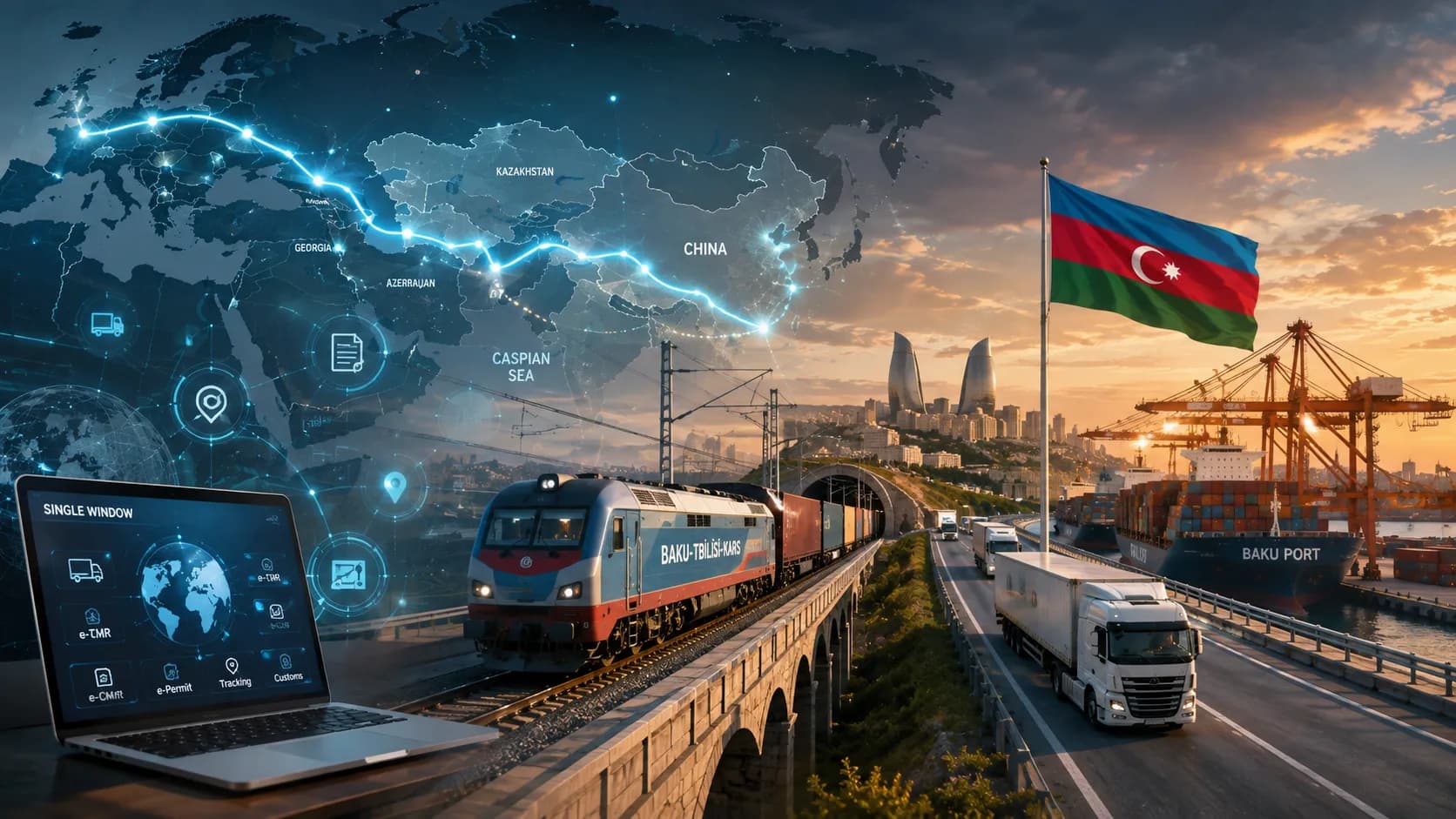
In a world where supply chains are increasingly intertwined and geopolitical maps shift with remarkable speed, the Middle Corridor is trying to establish itself as a practical alternative between China and Europe. Azerbaijan, situated at the heart of this route, is now advancing concrete steps in digitalization and transport development.
The numbers are encouraging, and the projects are ambitious. Yet the central question remains: are these reforms sufficient to turn the corridor from a promising pathway into a reliable artery? The question deserves a balanced assessment, without either exaggeration or pessimism.
Transit times are falling sharply
According to Azerbaijan’s Ministry of Digital Development and Transport, transit times for shipments along the China–Europe route have fallen from around 38–53 days a few years ago to an average of roughly 12 days today. The reduction is significant and rests on the introduction of electronic permit systems, e-TIR and e-CMR, real-time cargo tracking, simplified customs and border procedures, and faster information exchange among government agencies.
These are not empty slogans. Moving from paper to digital processes does reduce bottlenecks and shortens waiting times at borders.
Even so, the 12-day figure requires context. Field reports suggest that the actual average more often ranges between 12 and 18 days, and can stretch longer because of the Caspian Sea crossing, changes in railway gauges, or coordination challenges among the countries involved. The improvement is real, but it is not yet uniform along the entire corridor.
Infrastructure upgrades deliver results
On the infrastructure side, Azerbaijan has delivered tangible results. The annual capacity of the Baku–Tbilisi–Kars railway has been raised to 5 million tons (from around one million), border checkpoints have been modernized, the railway network has undergone electrification and upgrades, highways have been built or rehabilitated, and airport infrastructure has been developed. The most notable step is the creation of the Single Window information system — a digital logistics platform designed to accelerate document processing, simplify procedures, and offer companies a more flexible operating environment.
The next phase involves integrating this platform with comparable systems in partner countries along the corridor. The ministry is also working with international partners on the gradual rollout of tools such as e-CMR, e-Permit, and the electronic consignment note system e-CIM/SMGS.
These developments form part of a broader strategy. Azerbaijan is actively cooperating with Middle Corridor partners to strengthen transport links, improve border procedures, and expand digital data exchange. Modernization of the Baku–Tbilisi–Kars line, contracts for modern railway wagons, closer coordination among Caspian ports, and joint projects under the International Trans-Caspian Transport Route all aim to raise the corridor’s reliability and competitiveness. Bilateral and multilateral roadmaps have been prepared, agreements and memoranda of understanding signed, and work continues on a multilateral agreement that could provide an important institutional foundation for the corridor’s further development.
The Middle Corridor itself is a transport and trade route linking Asia with Europe through Central Asia, the Caspian Sea, Azerbaijan, Georgia, and Türkiye. It offers an alternative to the traditional northern and southern corridors and provides a land connection between China and Europe. In recent years cargo volumes have risen markedly, driven in part by disruptions on other routes. Azerbaijan is seeking to convert its geographical position into a lasting competitive advantage through digitalization.
Digital reforms mark a qualitative advance
Analytically, the digital reforms represent a genuine qualitative advance. The Single Window and related platforms can reduce bureaucracy, increase transparency, and improve the predictability of cargo flows. The introduction of e-TIR and e-CMR supports paperless cross-border operations — essential in a multimodal corridor spanning several countries. Raising the capacity of the Baku–Tbilisi–Kars line to 5 million tons addresses one of the main bottlenecks, particularly after modernization work on the Georgian section was completed.
Balance is still required, however. The corridor continues to face structural constraints: relatively limited capacity compared with maritime or northern routes, higher costs in certain cases, and potential bottlenecks at the Caspian crossing or in customs coordination. Digitalization alone cannot resolve shortcomings in physical infrastructure or differences in standards. Lasting success will depend on sustained cooperation with Kazakhstan, Turkmenistan, Georgia, and Türkiye, synchronized investment, and the confidence of major international operators who favor the most stable and predictable routes.
Strategic awareness drives the effort
Azerbaijan is therefore acting with clear strategic awareness. At a time of global supply-chain disruption, the Middle Corridor offers an attractive option for diversification. Digital reforms are not a luxury; they are a necessity if the route is to become genuinely competitive. Yet the path ahead remains long. Moving from project announcements to smooth daily operations will require time, sustained investment, and both political and technical continuity.
What Azerbaijan is doing today deserves close attention. The numbers are improving, digital platforms are being built, and carrying capacity is rising. This is more than an administrative upgrade; it is an attempt to redefine the country’s place on the Eurasian trade map. Success will be neither immediate nor guaranteed, but the direction is clear and the effort serious. In a world that needs multiple and flexible routes, the Middle Corridor remains a real opportunity — and Azerbaijan is positioning itself at its center.
Ultimately, the answer will come from results on the ground, not from press releases.
Abdul Hamid Hamid Al-Kba
Contributing writer at EUReflect.
Follow EUReflect
See more of our reporting on Google
Mark EUReflect as a preferred source and our stories are ranked higher for you in Top Stories, Discover and Google News — and carry a “preferred” badge when they are cited in AI results.
Add EUReflect as a preferred source