Weapons of the Next War
From AI-powered decision-making to drone swarms and hypersonic weapons, the next world war could be defined by speed, autonomy, and electronic dominance.
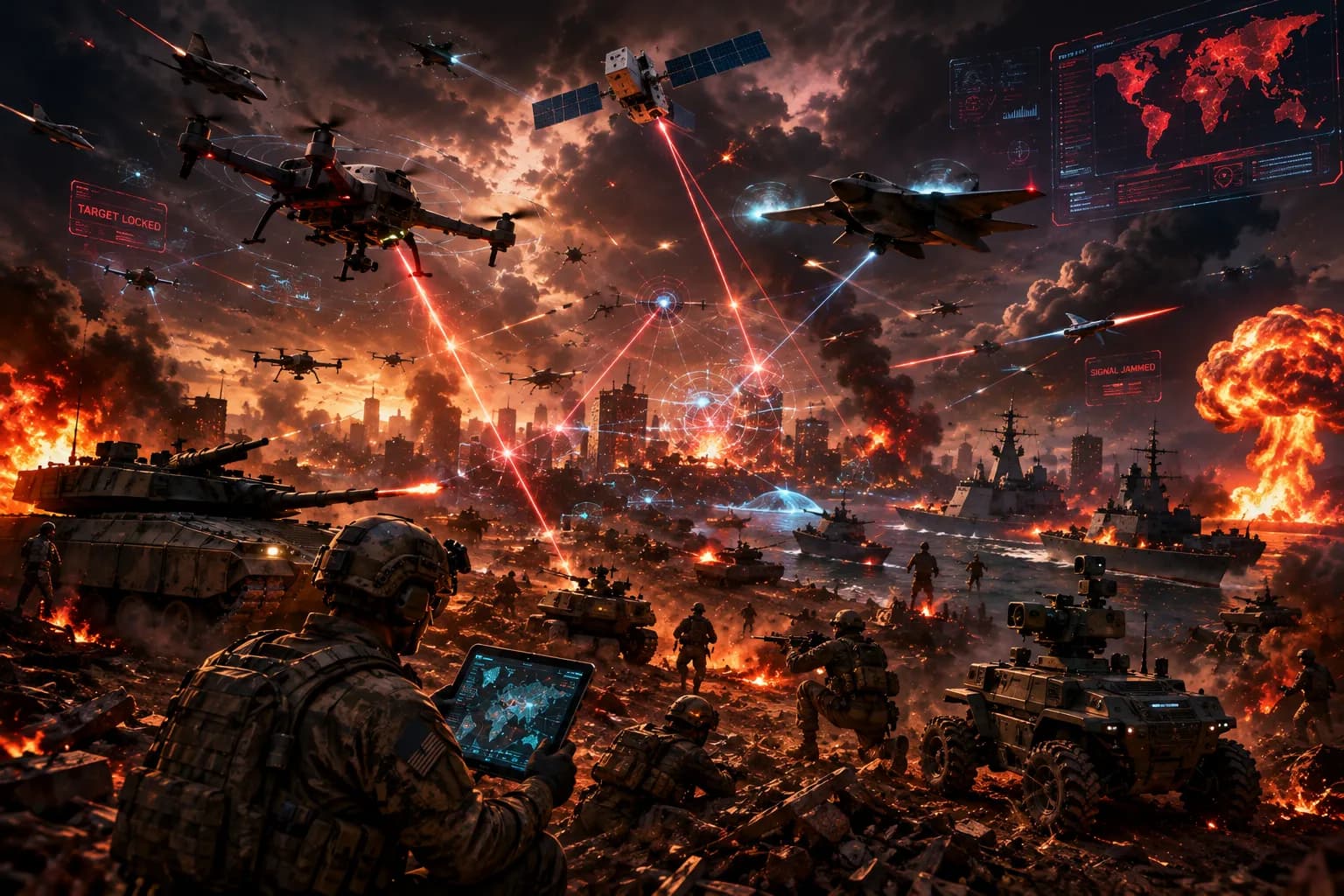
A future world war would likely look very different from the global conflicts of the 20th century. Aircraft, missiles, warships and armored vehicles would still matter, but developments in 2026 suggest that artificial intelligence, autonomous drones, hypersonic weapons, electronic warfare, cyber operations, satellites and directed-energy systems could determine which side sees, decides and acts first.
The transformation is already underway. The Pentagon’s 2026 AI strategy explicitly argues that AI-enabled warfare will redefine military affairs over the next decade, while recent conflicts are providing militaries with real-world lessons about drones, communications and electronic warfare.
AI Could Become the Battlefield’s Brain
Artificial intelligence may become one of the most important technologies in a future major-power conflict.
Modern militaries receive information simultaneously from satellites, aircraft, drones, radar, electronic sensors and ground forces. The problem is increasingly not obtaining information, but analyzing it before the enemy does.
AI systems can help process this enormous flow of data, identify patterns, track objects and present commanders with possible courses of action.
The Pentagon is already accelerating investment in this area. U.S. defense technology company Smack Technologies raised $61 million this month to expand systems designed to use computer vision and reinforcement learning for battlefield decision-making. Its technology is intended to help military units adapt more rapidly when conditions change or communications become unreliable.
In a future conflict, the side capable of turning sensor data into decisions in seconds could possess an enormous advantage.
Drone Swarms Could Overwhelm Defenses
The next transformation concerns numbers.
Ukraine has demonstrated how relatively inexpensive unmanned aircraft can threaten much more expensive military systems. The next stage could involve autonomous or semi-autonomous drones operating together.
Instead of sending one aircraft toward a target, future forces could deploy large numbers of interconnected unmanned systems across the air, land and sea.
Some could conduct reconnaissance. Others could act as decoys, interfere with communications or attack military targets. AI could coordinate their movements and redistribute tasks if individual systems were lost.
Recent U.S. military experimentation has consequently focused heavily on drones, AI and anti-jamming technology, reflecting lessons learned from Ukraine.
The economic implications are equally important. A military may find it difficult to use extremely expensive interceptor missiles against waves of comparatively cheap drones.
Future warfare could therefore become partly a contest of industrial scale: who can manufacture intelligent machines faster than the opponent can destroy them?
Hypersonic Weapons Compress Reaction Time
At the opposite end of the cost spectrum are hypersonic weapons.
These systems travel at more than five times the speed of sound, while some designs combine extreme velocity with maneuverability.
The United States is currently pushing ahead with another generation of hypersonic cruise-missile technology. DARPA is examining a Next Generation Hypersonic Cruise Missile program focused on greater range, speed, altitude and survivability against advanced air defenses.
Their strategic significance comes largely from time.
A faster and more maneuverable weapon can reduce the period available for detecting a threat, identifying its trajectory and deciding how to respond.
In a confrontation between major powers, increasingly compressed decision windows could also create a serious danger: political and military leaders may have less time to determine whether an incoming attack is limited or the beginning of a much larger operation.
Lasers Could Change Air Defense
Another technology moving toward practical military deployment is directed energy.
High-energy lasers and high-power microwave systems are being developed particularly for counter-drone and air-defense missions.
The attraction is partly economic. Once sufficient electrical power is available, a directed-energy system could potentially engage repeated threats without consuming conventional interceptor missiles after every shot.
U.S. defense officials are now calling for greater development of airborne directed-energy weapons and systems capable of countering drones.
Such weapons will not immediately replace missiles. Atmospheric conditions, power requirements, range and thermal management remain important technical limitations.
But they could create another layer of future air defense, particularly against large numbers of inexpensive unmanned aircraft.
The Invisible War Will Be Electronic
Some of the most important weapons of a future conflict may never create an explosion.
Electronic warfare systems can interfere with radar, navigation and communications. Cyber operations can target military networks and supporting infrastructure.
This means that a technologically sophisticated weapon can become far less effective if it loses the network connecting it to commanders, navigation systems or other platforms.
A future war could therefore begin before conventional weapons are fired.
Military networks could be attacked. Satellite communications could be disrupted. Navigation signals could be jammed or manipulated. Command systems could be targeted digitally.
Recent analysis of emerging warfare has increasingly highlighted this combination of cyberattack, satellite disruption and autonomous systems as a defining characteristic of future major-power conflict.
Space Becomes Part of the Battlefield
Modern militaries are deeply dependent on space.
Satellites support navigation, communications, missile warning, intelligence and reconnaissance. Removing those capabilities could leave technologically advanced forces partially blind.
This makes satellites strategic targets.
U.S. military officials are already examining threats ranging from cyber operations and directed energy to attacks against communications infrastructure supporting satellite constellations.
Future militaries may consequently require resilient constellations consisting of many satellites rather than relying on a small number of extremely valuable spacecraft.
The principle is similar to drone warfare: distributed networks can be harder to eliminate than a handful of expensive platforms.
Robots Could Fight Alongside Soldiers
Robotic warfare is also moving beyond aerial drones.
Ukraine's defense industry is developing unmanned ground vehicles for logistics, reconnaissance and evacuation alongside autonomous drones and unmanned maritime platforms. Hundreds of Ukrainian companies are now reportedly involved in robotic and unmanned military technologies.
A future battlefield could therefore contain mixed formations.
Soldiers might command reconnaissance drones overhead while unmanned ground vehicles carry ammunition and autonomous sensors monitor surrounding terrain.
Crewed fighter aircraft could similarly operate alongside AI-controlled “wingmen.”
The result would not necessarily be a battlefield without humans. Instead, humans could increasingly command groups of machines from greater distances.
The Network May Become More Important Than the Weapon
All these developments point toward a broader transformation.
The decisive weapon of a future world war may not be a single revolutionary missile, aircraft or robot.
It could be the network connecting them.
Imagine a satellite detecting activity and transmitting information to an AI system. The system combines that information with radar and drone data. A commander receives an assessment and assigns an unmanned platform to investigate while electronic-warfare systems monitor enemy communications.
What previously required multiple organizations and lengthy communication chains could happen increasingly quickly.
That creates a new definition of military superiority.
The strongest military may not simply be the one possessing the most tanks, aircraft or missiles. It may be the force capable of connecting satellites, sensors, algorithms, drones, robots, cyber systems and conventional weapons into one resilient network.
The Greatest Risk Is Speed
Technology may make future militaries more precise, but it could also make international crises more dangerous.
AI shortens analysis time. Hypersonic weapons shorten warning time. Autonomous systems shorten response time. Cyber operations can create uncertainty about what is actually happening.
Together, these technologies could place enormous pressure on commanders to react before they possess complete information.
That is why the debate over human control is becoming as important as the technology itself. Recent discussion around autonomous drones has emphasized the difficulty of maintaining accountability and compliance with the laws of war as machines receive greater operational independence.
The future arms race is therefore not simply about building more destructive weapons.
It is becoming a race to see first, understand first and act first.
And in a future global conflict, the most dangerous technology may ultimately be the one that leaves humans too little time to decide whether a war should escalate at all.
Ahmet Balakan
Contributing writer at EUReflect.
Follow EUReflect
See more of our reporting on Google
Mark EUReflect as a preferred source and our stories are ranked higher for you in Top Stories, Discover and Google News — and carry a “preferred” badge when they are cited in AI results.
Add EUReflect as a preferred source