China Accelerates AI Push Across the Economy Under “AI Plus” Initiative
The State Council's August 2025 guideline sets AI integration targets of 70% by 2027 and 90% by 2030 across key sectors, with scientific discovery as the top priority.
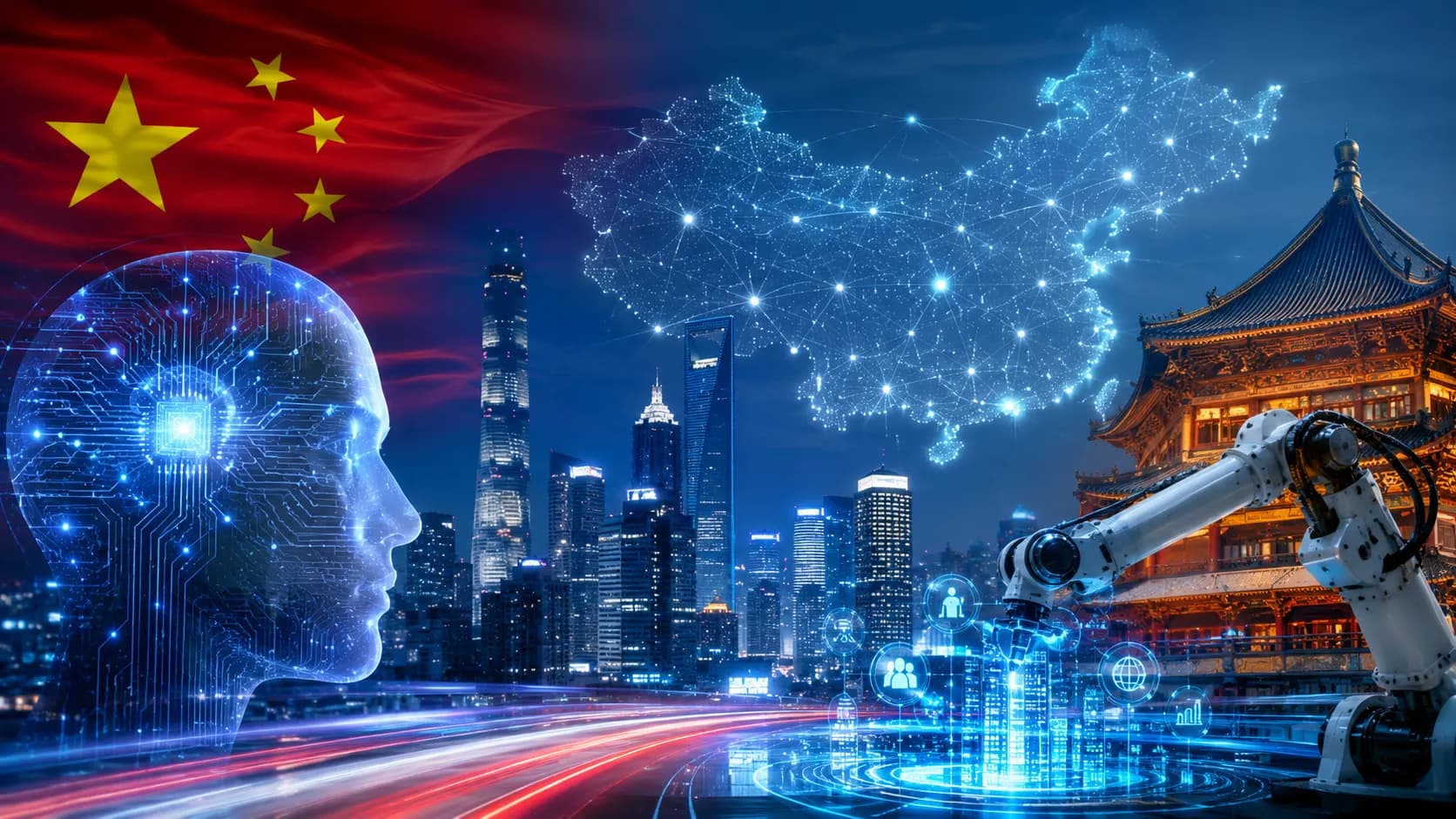
In China, artificial intelligence is no longer a laboratory subject — it is the backbone of state policy. The comprehensive guideline published by the State Council in August 2025 placed the "Artificial Intelligence Plus" (AI+) initiative at the centre of the country's social and economic development. Under the plan, extensive and in-depth integration of AI is to be achieved by 2027 across six key areas — science and technology, industry, consumption, public well-being, governance, and global cooperation; by 2030, AI is to comprehensively empower China's "high-quality development." The initiative also entered the recommendations for the 15th Five-Year Plan (2026-2030) with a call to "advance the AI+ initiative across the board."
Ambitious Targets: 70 Per Cent by 2027, 90 Per Cent by 2030
The initiative's numerical targets reveal the scale of the transformation. The guideline envisions the penetration rate of AI-powered "intelligent terminals" and AI agents exceeding 70 per cent across key sectors by 2027, with the 2030 target reported as 90 per cent. According to analysts, the document's first-ranked goal is the acceleration of scientific discovery: equipping scientists with AI tools, developing large scientific models, and creating interdisciplinary open datasets are defined as a priority that will act as a "force multiplier" for all other goals.
What the Field Shows: From Robotaxis to AI-Powered Public Services
The distinguishing feature of the Chinese model is its focus on practical application rather than theoretical capability. Robotaxis, medical imaging systems, and AI applications integrated into public services are already transforming daily life; new scenarios such as connected vehicles and smart products keep emerging one after another. The application emphasis is not new: the term "AI+" appeared in both the 2024 and 2025 government work reports, with the 2025 report specifically highlighting smart vehicles, robots, and manufacturing equipment. Experts assess that this approach replicates the recipe of areas where Beijing has previously outpaced rivals — from solar panels to electric vehicles — and could challenge European strengths such as industrial automation.
The Human Dimension: An Institutional Response to Employment Concerns
The social cost of diffusion is also on the agenda, and Beijing is producing institutional responses to this dimension. In 2025, a Chinese court ruled that replacing a worker with an AI system cannot, on its own, constitute valid grounds for dismissal, and the ruling was published as a "model case." The State Council's AI+ guideline likewise mandates strengthening employment risk assessments for AI applications and directing innovation resources towards areas with greater job-creation potential; the Labour Ministry's announcement in January 2026 of a dedicated policy on AI's impact on employment is a continuation of the same line.
Conclusion
The AI+ initiative moves China's AI strategy beyond the model race and turns it into a strategy of diffusion: the goal is less to build the most powerful model than to embed AI into every cell of the economy — from factory to hospital, from school to municipality. Read together with the concrete penetration targets tied to the 2027 and 2030 thresholds, the emphasis on an open-source ecosystem, and the institutional mechanisms managing employment risk, what emerges is a model that weaponises scale and application in global competition. The success of this model will determine not only the productivity of the Chinese economy but also the rules of the global AI race.
Alvara Merrick
Contributing writer at EUReflect.
Follow EUReflect
See more of our reporting on Google
Mark EUReflect as a preferred source and our stories are ranked higher for you in Top Stories, Discover and Google News — and carry a “preferred” badge when they are cited in AI results.
Add EUReflect as a preferred source