From Aid Paternalism to Productive Investment: Lessons from the EuropAfrica Investment Forum 2026
On 2 October 2026, the EuropAfrica Investment Forum at the European Parliament marked a clear call to end the traditional aid model. Speakers including Louis Michel and DRC Minister Julien Paluku argued that decades of development assistance have failed to transform African economies, which still capture only 3% of the value of their resources. The real priority, they insisted, is industrialisation, local processing of critical minerals, and a shift from grants to investment-support instruments. Shared prosperity, not aid, is presented as the only sustainable answer to migration and the foundation for a genuine Europe-Africa partnership.
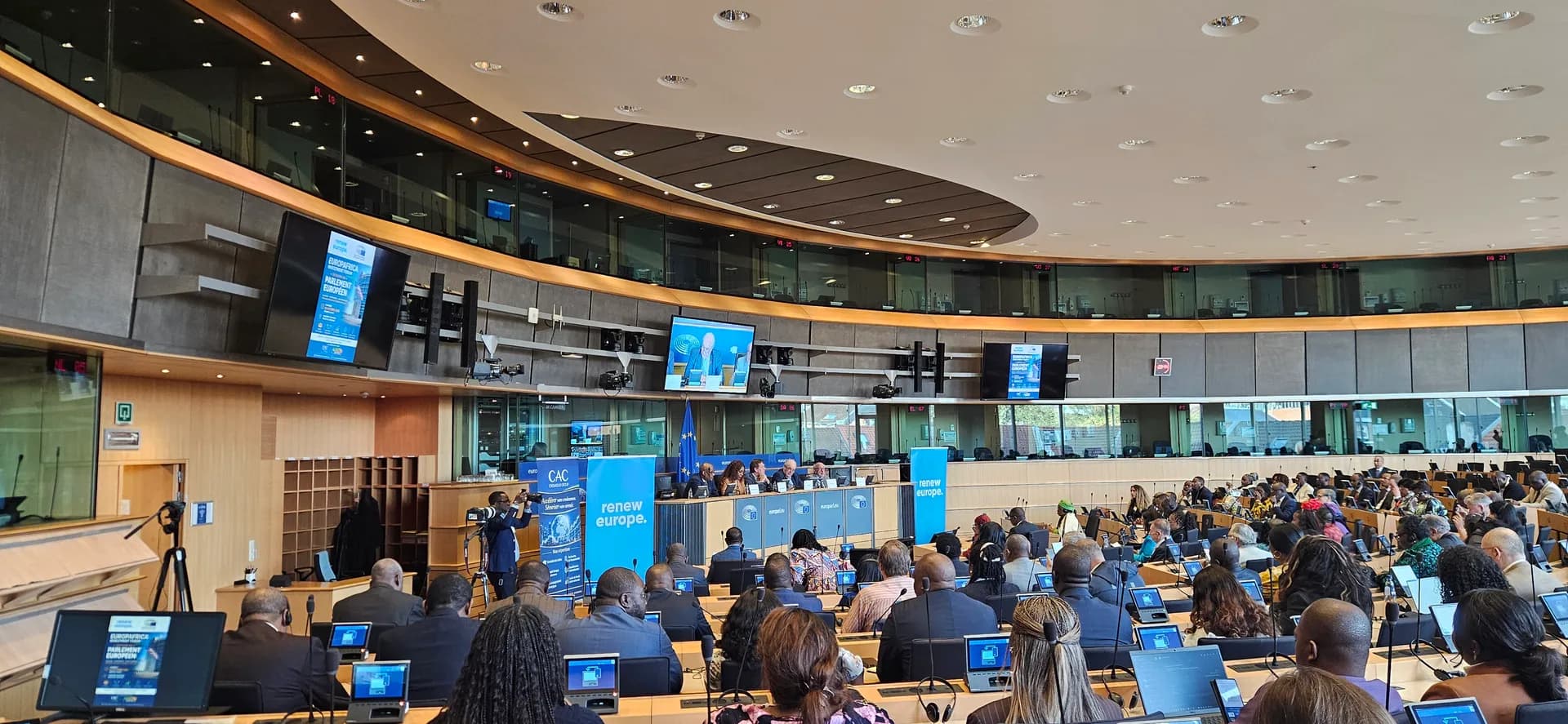
From Aid Paternalism to Productive Investment: Lessons from the EuropAfrica Investment Forum 2026 at the European Parliament
On 2 October 2026, the European Parliament in Brussels hosted the institutional closing day of the EuropAfrica Investment Forum 2026, organised by CREDASSUR GROUP under the high patronage of the Parliament. This session, framed around the shift from an aid logic to one of investment partnership and co-production, provided a dense and revealing snapshot of the current state of Europe-Africa relations. Interventions by Louis Michel, Belgian Minister of State and former European Commissioner for Development; Julien Paluku Kahongya, Democratic Republic of Congo’s Minister of External Trade; Justine Nthomeng Majara, Deputy Prime Minister of Lesotho; as well as representatives of the African Union and the European Commission, offered a rigorous opportunity to revisit the history of cooperation, assess the structural limits of European development policy, and advance concrete proposals on development financing.
A Long History of Asymmetric Relations
Europe-Africa relations predate independence. They are rooted in a shared—and often painful—history of colonisation, common languages (four European languages remain official or widely spoken across Africa), and enduring cultural ties. Louis Michel recalled that this geographic and historical proximity makes the two continents “natural allies.” Yet the post-independence institutional framework long remained structured around aid rather than equal partnership.
The Yaoundé Conventions (1963 and 1969), followed by the Lomé Conventions (1975–2000) and the Cotonou Agreement (2000), organised ACP-EU relations around non-reciprocal trade preferences and substantial Official Development Assistance (ODA). While these instruments facilitated certain transfers and political dialogue, they failed to prevent the persistence of a rent-based economy centred on the export of unprocessed raw materials. As Julien Paluku underlined, Africa still captures only around 3% of the value added from its resources. The Economic Partnership Agreements (EPAs), negotiated in the 2000s under the responsibility of Louis Michel among others when he served as Commissioner, sought to introduce progressive reciprocity and strengthen regional integration. Their record remains mixed: sovereignty-based resistance on both sides, asymmetries in negotiating capacity (which the Commission attempted to mitigate by financing African experts), and difficulty in moving beyond regional frameworks toward a continental vision.
The 2026 Forum stands in continuity with this long trajectory while explicitly claiming a break. The African Union’s Agenda 2063, the African Continental Free Trade Area (AfCFTA), and the European Global Gateway initiative (€150 billion announced for Africa) all signal a stated desire to move beyond the donor-recipient paradigm.
Structural Limits of European Development Cooperation Policy
Louis Michel delivered an uncompromising diagnosis. As a privileged observer during his tenure as Commissioner for Development and Humanitarian Aid, he stressed that policies primarily channelled through NGOs and United Nations agencies—however well-intentioned—have not delivered the structural transformation required. One additional percentage point of growth in Africa, he noted, is worth roughly two and a half times the volume of official development assistance. Africa needs industrialisation, local processing of raw materials, and genuine access to world markets—not merely an economy of small-scale independence.
The critique also targeted the occasionally paternalistic character of the traditional approach and the instrumentalisation of migration. For Michel, migration is a historical and natural phenomenon that has often benefited host countries. The only sustainable way to manage it is to create prosperity where people live, through productive investment policies rather than walls or security rhetoric. He insisted on a fundamental point: a free-trade area worthy of the name cannot be limited to goods. Freedom of movement for people forms an integral part of the concept; without it, the European project itself—founded on democracy, pluralism, and the universality of rights—is emptied of meaning.
On the African side, Minister Paluku converged in calling for a “redefinition of strategies” and a shift “from discourse to concrete action.” Europe, he argued, cannot continue to “transgress” the values it claims to defend by maintaining an extractive relationship. The DRC, holder of major reserves of cobalt, copper, lithium, manganese, and nickel, illustrated the argument with concrete figures drawn from a Bloomberg study: the cost of installing a critical-minerals processing plant would be approximately $39 million in the DRC, compared with $65 million in Poland, $112 million in China, and $117 million in the United States. Processing on site creates value, employment, and reduces migratory pressure. The lack of reliable information and stereotypical narratives about Africa (a continent of misfortunes, wars, etc.) continue to deter investors.
Financing Development: From Qualitative Aid to Support for Investors
The core of the debate centred on the financing model. Louis Michel advocated transforming traditional aid into financial support for investors, grounded in the principles of ownership and incentive. He recalled an earlier Belgian-European proposal—never implemented—for a fund financed by DRC natural resources in which every Congolese euro would have been matched by two from the European Union. Access to finance, technology transfer, joint ventures between European and African companies, and the strengthening of states (sovereign functions, justice, anti-corruption efforts, redistribution) were presented as the essential conditions for a genuine shared-prosperity zone.
The Lesotho representative highlighted sectoral opportunities—water and renewable energy (Lesotho being the “water tower” of Southern Africa), agriculture and agro-processing, tourism, manufacturing, and digital infrastructure—as well as the country’s role as a gateway to the AfCFTA market. Competitive wages, relative stability, and electrification rates were underlined as additional advantages for European investors.
On the African side, concrete advances of the AfCFTA—particularly the Pan-African Payment and Settlement System (PAPSS), which enables transactions in local currencies without routing through the dollar or the euro—were presented as evidence that the continent is advancing faster than the European construction itself (from the 1957 EEC to the Maastricht Treaty). Africa, it was stressed, will not wait 45 years.
Prospects and Conditions for Success
The Forum recommended the drafting of a joint roadmap by the European Commission and the African Union Commission. Parliamentarians—European and African alike—have a decisive role to play: beyond ratification, they must monitor implementation, demand transparency, ensure the inclusion of local value chains and technology transfer, and oversee the effective allocation of funds (Global Gateway, trade-facilitation mechanisms, infrastructure). Inter-parliamentary cooperation (ACP-EU Joint Parliamentary Assembly, Inter-Parliamentary Union, and others) and the strengthening of legislative capacities are essential.
The political message is clear: Europe and Africa stand to gain from a balanced partnership. African industrialisation is not merely an economic question; it is a condition of dignity, sovereignty, and stability—including for Europe. Creating wealth where resources and young populations are located is an investment in the stability of both continents. Rhetoric alone is no longer sufficient. What is now required are quantified objectives, identified means, designated responsibilities, and rigorous parliamentary follow-up.
The EuropAfrica Investment Forum 2026 did not invent these ideas. It resituated them within a context of geopolitical recomposition and global energy transition, in which critical minerals, value chains, and productive investment have become instruments of power. The history of Europe-Africa relations has been one of prolonged asymmetry. If the future is to be shared, it must be one of co-produced prosperity.
Related Topics
Follow EUReflect
See more of our reporting on Google
Mark EUReflect as a preferred source and our stories are ranked higher for you in Top Stories, Discover and Google News — and carry a “preferred” badge when they are cited in AI results.
Add EUReflect as a preferred source