Pakistan’s Fast-Rising Solar Power Revolution
Pakistan is experiencing a rapid, people-driven shift to solar energy as households and businesses seek relief from high costs and unreliable power. Falling technology prices and massive private investment have fueled growth, while new regulations create uncertainty about future expansion.
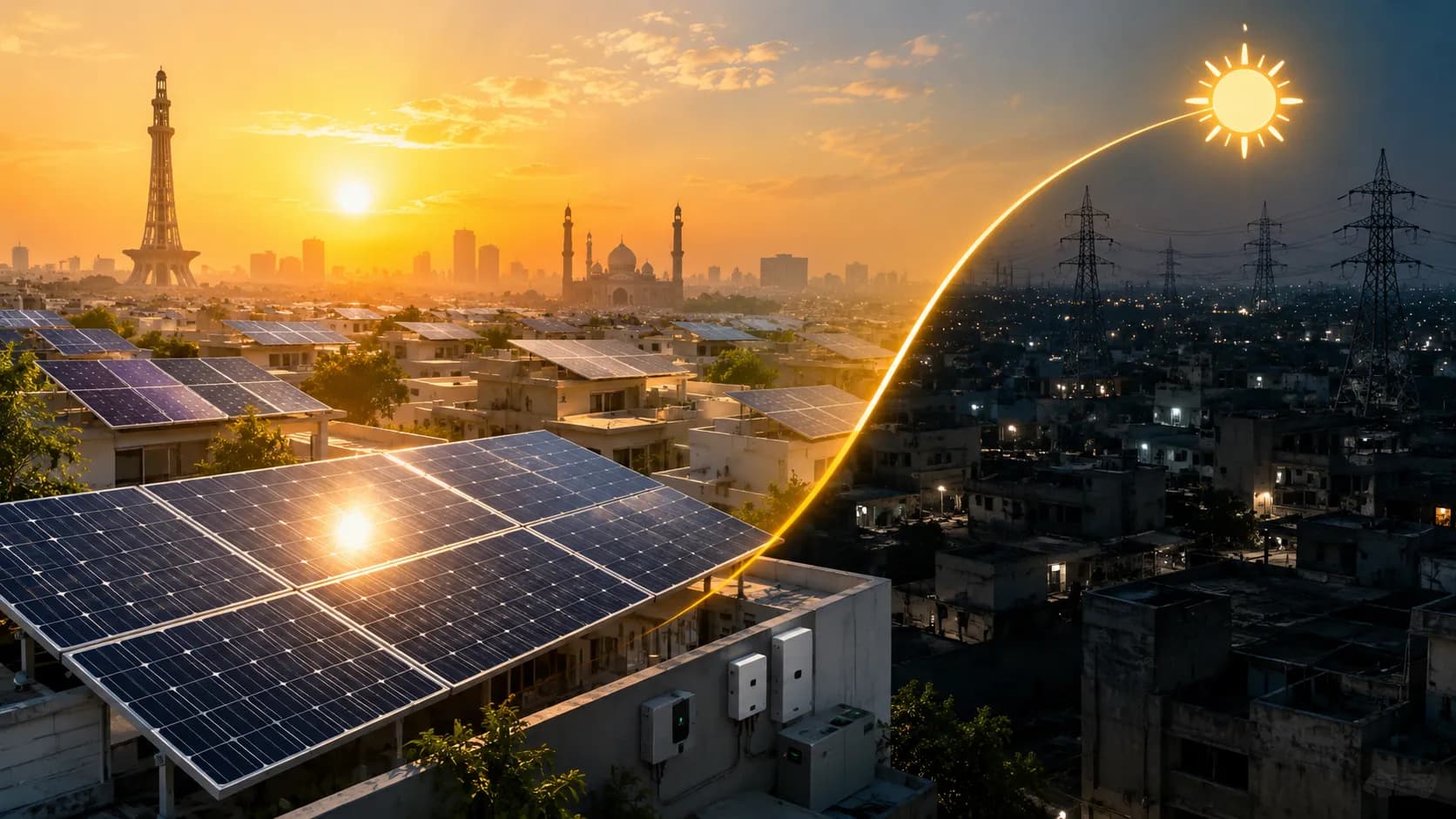
Pakistan is going through a huge change in how it gets electricity. This change is not being led by the government. Instead, ordinary people, shop owners, and factory managers are driving it because they are tired of expensive electricity bills and frequent power cuts. They have turned to solar energy, and the speed of this shift has made Pakistan one of the fastest-growing solar markets in the world. In just a few years, solar power has gone from a rare luxury to a common sight on rooftops across the country.
The numbers tell a dramatic story. In 2024 alone, Pakistan imported 17 gigawatts of solar panels. That made it the biggest importer of solar panels in the world for that year. To put that in perspective, 17 gigawatts is more than many countries have installed in total over a decade. During the same financial year, Pakistanis spent $2.1 billion on bringing solar panels into the country. This huge investment came from private savings and business funds, not from foreign aid or government loans. Between 2022 and 2024, the price of solar panels dropped by five times, making them affordable for millions of families. At the same time, the cost of lithium-ion batteries, which store solar energy for use at night, fell by 44.5 percent. This price drop has been the real engine of the solar revolution.
Then came the new government policies. As solar adoption exploded, Pakistan’s power sector found itself in a difficult position. More people generating their own electricity meant less revenue for the national grid, even as the government remained obligated to make fixed capacity payments to power producers. In response, the government introduced major changes to net metering regulations. The Economic Coordination Committee (ECC) approved amendments in early 2025, revising the buyback rate from approximately Rs27 per unit to Rs10 per unit. This was later adjusted to Rs11 per unit in December 2025, down sharply from the previous rate of Rs25.98 per unit. The contract duration for solar agreements was also reduced from seven years to five years. What was once a simple unit-for-unit offset system was replaced with a net billing model, where exported and imported electricity are now billed separately, with exported units purchased at the fixed lower rate while imported grid electricity continues to be billed at prevailing slab-based retail tariffs , often well above Rs30 per unit. The government argued that without these changes, solar consumers would transfer an unsustainable financial burden onto grid-dependent households. However, the Pakistan Solar Association warned that halving the buyback rate could extend solar system payback periods from three–four years to 10–12 years, potentially discouraging future investments.
The government’s push for tighter regulation continued into 2026. In April of that year, NEPRA ended the free facility for solar installations and made licensing mandatory for all system sizes, introducing a processing fee of Rs1,000 per kilowatt for new applicants. Under the new framework, even small-scale residential systems were required to obtain formal concurrence from the Authority, centralising the approval process in a way that was previously reserved only for installations above 25 kilowatts. This move drew sharp criticism from industry bodies, including the Pakistan Solar Association, which argued that stripping distribution companies of approval authority created unnecessary bureaucratic hurdles. The Power Division itself formally requested NEPRA to review the framework and restore maximum facilitation for solar consumers up to 25 kilowatts in the form of zero license fee and no licensing requirement for smaller systems. In a separate intervention, Prime Minister Shehbaz Sharif personally directed the Power Division to file a review appeal, instructing that every possible safeguard should be extended to existing consumer contracts to prevent costs from being unfairly shifted onto other electricity consumers.
Despite the regulatory tightening, the government is also aggressively expanding Pakistan’s wider clean energy ambitions. In early April 2026, officials informed a high-level meeting that 55 percent of the country’s electricity was already being produced from renewable sources, while 45 percent came from fossil fuels. Planning is under way to increase the renewable share to 90 percent over the next 10 years, a move aimed at cutting dependence on imported fuel. Prime Minister Shehbaz Sharif has repeatedly directed authorities to formulate a comprehensive renewable energy strategy, emphasising that increased generation from hydropower, solar energy, biogas and other renewable resources would help reduce production costs and positively impact economic growth. The Prime Minister’s office reported that power distribution losses had declined from 18.3 percent in June 2024 to 15.3 percent in March 2026, while electricity bill recovery improved significantly to 96.46 percent in March 2026, compared to 90 percent in June 2024. The government also allocated Rs14 billion through the Prime Minister’s National Programme for Solarisation of Agriculture Tube Wells, demonstrating that while net metering incentives have been reduced for households, support for solar in the agricultural sector remains a priority.
Meanwhile, the solar revolution continues to deliver immense benefits. It is estimated that solar now provides about 25 percent of all electricity consumed in Pakistan. As of early 2026, Pakistan generates 34 gigawatts of electricity from solar energy. What is remarkable is that 28 gigawatts of this comes from small rooftop installations on houses, shops and factories. Only about 1.5 gigawatts comes from large, government-style solar farms. This means the revolution is truly decentralized, people are producing their own power where they use it. Because so many people have switched to solar, demand for grid electricity dropped by 10.4 percent in the 2024 financial year. Electricity sales by distribution companies also fell by 3 percent between 2023 and 2024. This is a shocking reversal. The grid used to be the only source of power; now it is becoming a backup for millions of households.
There are also major economic benefits for the whole country. Pakistan used to spend billions of dollars every year importing oil, gas and coal to run its power plants. These imports drained the country’s foreign currency reserves. But thanks to solar power, Pakistan saved approximately $12 billion in import bills between 2018 and 2026. That money can now be spent on other things like schools, hospitals and roads. Additionally, the solar boom has created thousands of new jobs in panel installation, maintenance, sales and even local assembly of components. Young workers in cities like Lahore, Karachi and Islamabad are finding steady work fitting panels on rooftops and wiring batteries. The environment is also benefiting. Solar power produces no smoke or greenhouse gases. By replacing fossil fuel electricity, Pakistan has reduced its air pollution in many cities.
Of course, the current policy standoff remains an open question. After the introduction of licensing fees and stricter net billing rules, some potential solar buyers may pause their decisions while awaiting further clarity. But analysts note that even if regulatory conditions become less favourable, the falling costs of solar panels and battery storage may continue to drive adoption, particularly for consumers who choose to operate entirely off grid. As battery prices continue to decline, more households will be able to store solar power for the night, reducing their dependence on the grid even further.
Pakistan is not just going solar, it is showing the rest of the world what a grass-roots energy revolution looks like. The country has gone from being an energy-poor nation to a solar leader in less than five years. The challenge now is not how to build more solar capacity, but how to manage the new energy future that has already arrived. With half of the country’s power already coming from renewables and a stated target of 90 percent by 2034, Pakistan is well on its way to becoming a true renewable revolution country.
Uroosa Khan
Contributing writer at EUReflect.
Follow EUReflect
See more of our reporting on Google
Mark EUReflect as a preferred source and our stories are ranked higher for you in Top Stories, Discover and Google News — and carry a “preferred” badge when they are cited in AI results.
Add EUReflect as a preferred source