Türkiye Emerges as Europe’s Key Black Sea Partner
Turkey's role is concretized through the MCM Black Sea task group, which has conducted 10 activations, and its mandate is being extended to cover energy assets like the Sakarya Gas Field.
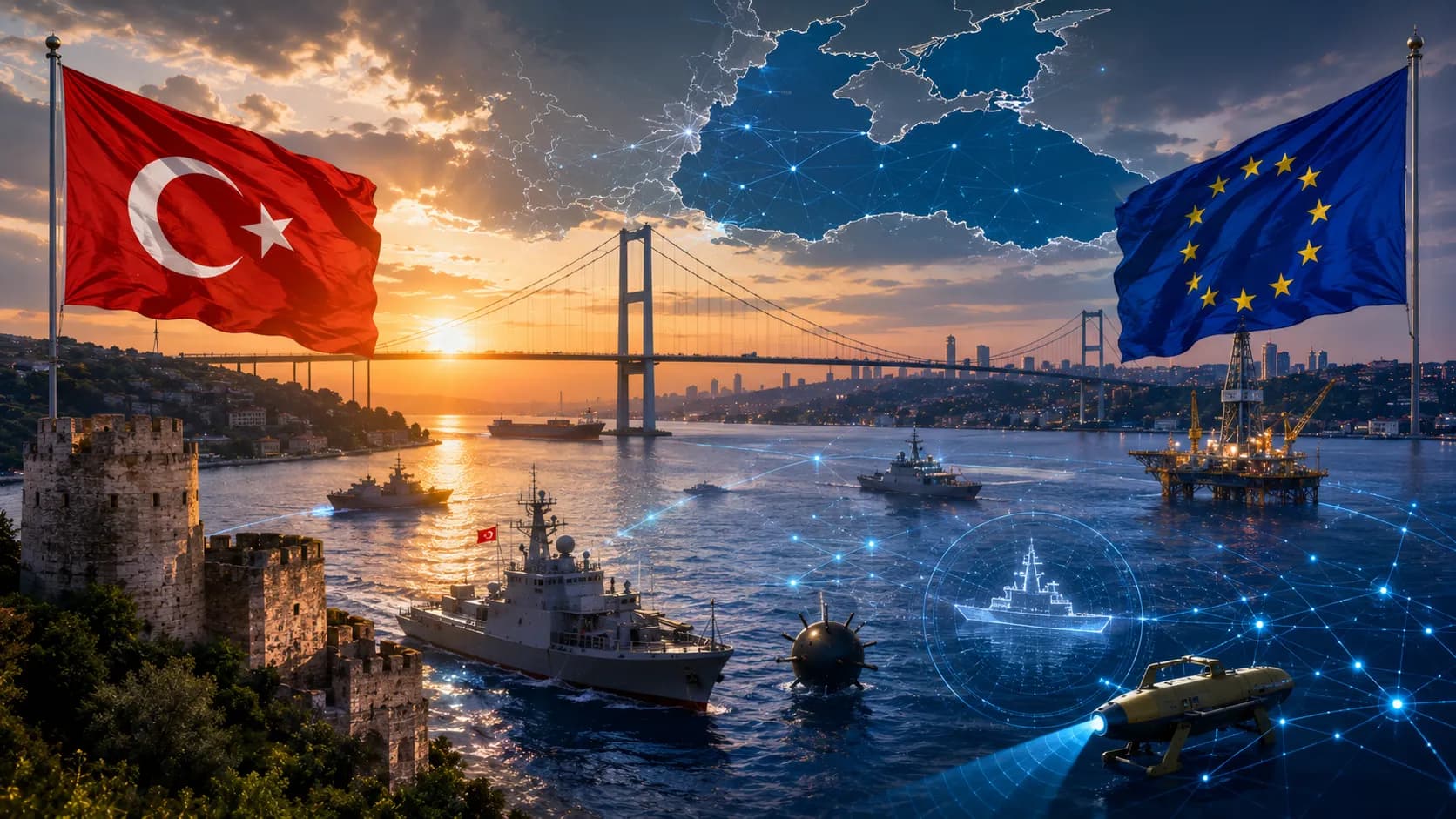
In the Black Sea, which has turned into the frontline of European security since 2022, the country that sets the balance is Turkey. Holding the regime of the Istanbul and Çanakkale straits under the Montreux Convention, Ankara has applied the convention in a "responsible and impartial" manner since the outbreak of the war, playing a leading part in diplomatic initiatives aimed at ending the conflict, establishing the grain corridor, and delivering humanitarian assistance. The Black Sea Strategy unveiled by the European Union in May 2025, in turn, opened a new window of cooperation on the Ankara-Brussels axis by defining Turkey as a "constructive" partner in regional security. So where does Turkey's role take concrete form, and through which channels can it deepen with Europe?
The Concrete Role in the Field: The Turkish-Led MCM Black Sea
Turkey's most visible contribution to Black Sea security is the Mine Countermeasures Task Group (MCM Black Sea) it has spearheaded. After naval mines drifting from Russian and Ukrainian ports began threatening the safety of navigation, Turkey, Romania, and Bulgaria signed a memorandum of understanding in Istanbul in January 2024; according to analysts, the initiative is a concrete manifestation of the balancing policy Turkey pursues in the region and a valuable product for the international security architecture beyond the littoral states. The task group has now reached a routinised operational tempo: the 10th activation, held on 13-24 June 2026 with the participation of TCG Ütğm. Arif Ekmekçi and TCG Ayvalık, was conducted under Turkish command. Moreover, during the NATO Summit process in Ankara it was decided to extend the task group's mandate beyond mine clearance to cover the protection of critical undersea energy infrastructure, such as Romania's Neptun Deep and Turkey's Sakarya Gas Field — the trilateral initiative is evolving into a regional "security shield."
Brussels' New Vision: The Black Sea Strategy and the Maritime Security Hub
On the European side, the institutional ground is also in place. The Strategic Approach to the Black Sea presented by EU High Representative Kaja Kallas in May 2025 rests on three pillars — security and stability, sustainable prosperity and connectivity, and environmental resilience — and, as its flagship initiative, envisages the establishment of a Black Sea Maritime Security Hub. The hub will focus on protecting critical maritime infrastructure through real-time monitoring, information exchange, and maritime situational awareness; the strategy also explicitly includes encouraging regional cooperation on demining. The document assigns Turkey a specific role: it is expressly emphasised in the strategy that Ankara "can play a constructive role" in countering Russia's shadow fleet and in strengthening maritime safety, energy security, and connectivity. The first implementation report, published in July 2026, shows that the strategy has not remained on paper.
The Channels of Cooperation: From the Trilateral Model to the European Architecture
There is a natural complementarity between Turkey's field experience and Brussels' institutional instruments, and multiple channels stand out for cooperation. The first is coordination between the accumulated experience of MCM Black Sea and the EU Maritime Security Hub: the data and situational awareness sharing of a task group that already operates jointly with two NATO and EU members (Romania and Bulgaria) could be the hub's quickest win. Second, it is reported that, for the reassurance force being discussed for Ukraine in the event of a ceasefire, Turkey has offered to lead the maritime component — ensuring safe passage in the Black Sea and conducting mine clearance — an offer that directly fills Europe's capability gap. Third, the strategy's provisions foreseeing the development of maritime assets and satellite-based monitoring through PESCO and European Defence Fund projects open a door to the Turkish defence industry's accumulated expertise in unmanned naval vehicles and mine-hunting technologies. The common denominator of all these channels is respect for the Montreux regime: as experts underline, Turkey's impartial application of the convention has been the fundamental anchor preventing escalation to date, and it will remain the foundation of any formula to be built with Europe.
Conclusion
The security equation of the Black Sea depends on Ankara to a degree that makes it impossible to construct without Turkey: as the custodian of Montreux, the largest naval power among the littoral states, and the founding pioneer of MCM Black Sea, Turkey is the carrier of both deterrence and dialogue in the region. The EU's new strategy naming Turkey as a constructive partner and proposing concrete mechanisms such as the Maritime Security Hub offers a realistic framework in which the two sides can combine their capabilities. When the coordination of the trilateral mine initiative with the European architecture, Turkish leadership of the maritime component of a reassurance force, and defence industry partnerships are realised — all on the basis of respect for the Montreux anchor — the Black Sea can become not merely a frontline but a basin of cooperation where Ankara and Brussels produce security together.

İsmail Polat
Ph. D. in International Relations
Follow EUReflect
See more of our reporting on Google
Mark EUReflect as a preferred source and our stories are ranked higher for you in Top Stories, Discover and Google News — and carry a “preferred” badge when they are cited in AI results.
Add EUReflect as a preferred source