Can the Makkah Pact Survive the Houthi Challenge?
Houthi ballistic missiles and drones have struck Riyadh and other strategic sites, while Saudi Arabia has reportedly sought extra interceptor stocks to sustain its air defences.
Testing the Makkah Pact
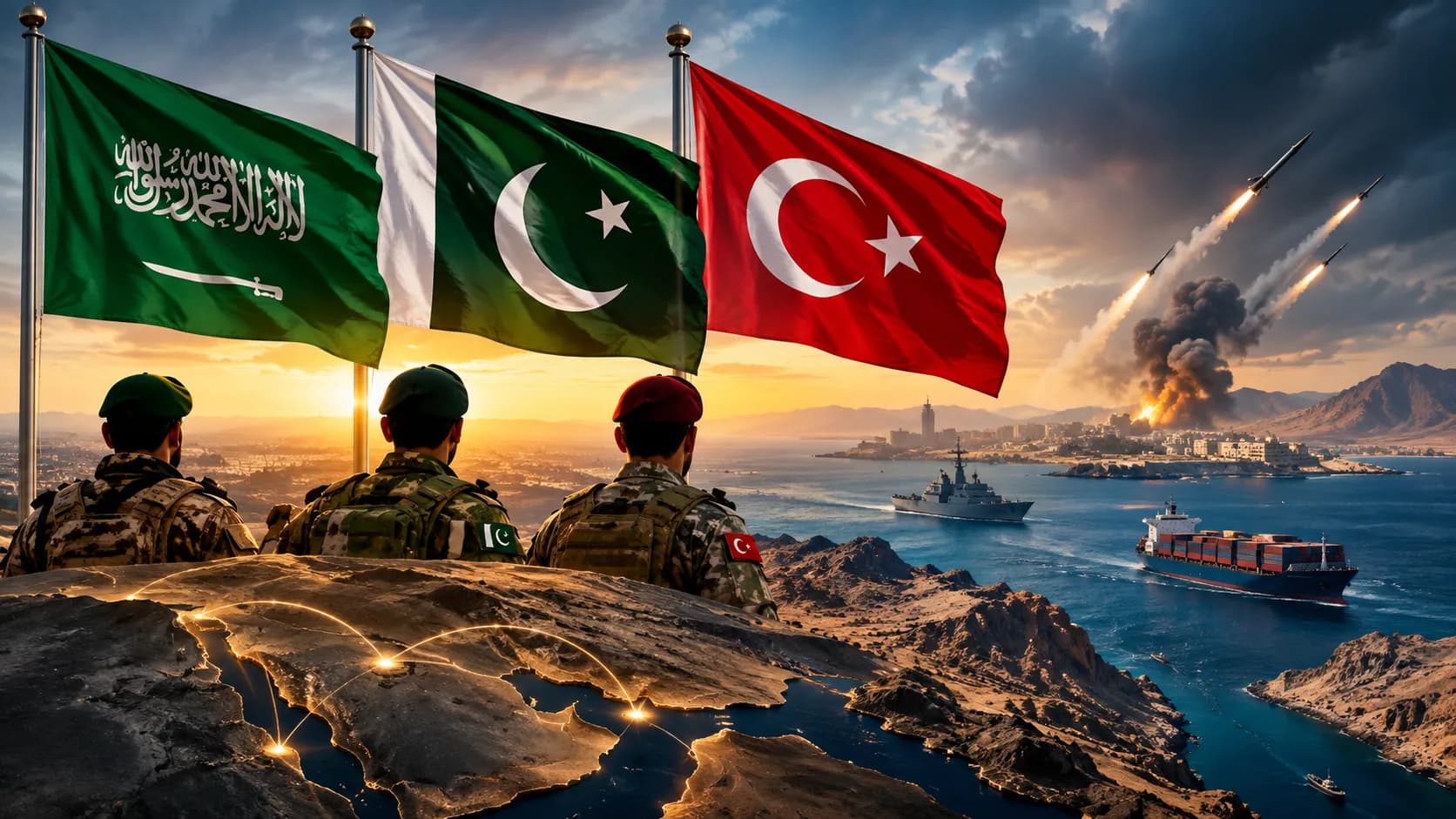
The Houthi military escalation against Saudi Arabia in September 2026 has provided an important early test of the Makkah Joint Defence Agreement signed by Saudi Arabia, Pakistan and Türkiye on 7 August 2026. The agreement was presented as a new regional security framework intended to strengthen collective defence and respond to growing uncertainty surrounding traditional American security guarantees. However, the rapid escalation of attacks has exposed a significant difference between the political ambitions of the agreement and its current operational capacity. While the pact establishes an important framework for cooperation, it is still developing the institutions, military coordination and procedures required for a fully operational collective defence arrangement. The agreement itself states that an armed attack against one member is to be regarded as an attack against all three, while also committing the countries to broader defence cooperation.
The Houthi attacks demonstrate the scale of this challenge. Ballistic missiles and drones have targeted Saudi territory, including Riyadh and other strategic locations. The Houthis have also expanded their position around the Red Sea, increasing concerns about maritime security and the Bab al Mandab route. Saudi air defence systems have intercepted incoming projectiles, but interception does not remove the underlying threat. The continued ability of the Houthis to launch attacks means that Saudi Arabia remains exposed to repeated military and economic pressure. Recent reports also indicate that Saudi Arabia has sought additional assistance because of concerns over missile interceptor stocks.
The Houthi approach can be understood as coercive diplomacy supported by military force. Their attacks have been accompanied by demands concerning Saudi policy toward Yemen, restrictions on Yemen and the wider regional conflict. The continuing attacks suggest that the Houthis are attempting to increase the cost of Saudi military and political involvement while strengthening their bargaining position. The consequences are not limited to Saudi Arabia. Disruption around major maritime routes can affect energy markets, shipping and international trade. This makes the conflict an international economic issue as well as a regional security crisis.
Türkiye's role in the pact
Türkiye's role in the Makkah Pact is particularly important. It is not simply another signatory. Türkiye brings a large military establishment, an established defence industry and long experience within NATO's collective security system. The first Strategic Political and Defence Committee meeting was held in Istanbul on 31 August, bringing together senior political and military officials from all three countries. The three governments subsequently agreed to further institutionalise their cooperation, establish a secretariat and strengthen defence industry cooperation and joint technology development.
Recent developments suggest that Türkiye may become increasingly important if the Saudi threat continues. On 19 September, Turkish Foreign Minister Hakan Fidan said that Saudi Arabia might have military and technical needs because of the Houthi attacks and that Türkiye was ready to assist under the defence agreement. This is significant because it moves Türkiye's position beyond general political solidarity toward a discussion of practical military assistance. However, assistance with technical capabilities, air defence or equipment would still be different from sending Turkish forces into Yemen for offensive operations.
Pakistan's balancing position
Pakistan's position is more complicated. Islamabad has publicly stressed that it will respect the terms of the defence agreement, and Defence Minister Khawaja Asif stated that aggression against Saudi Arabia could activate the pact. At the same time, Pakistan has continued to encourage Iran to restrain the Houthis. This reflects Islamabad's attempt to maintain its relationship with Saudi Arabia without completely closing its diplomatic channel with Tehran.
This balancing strategy is likely to remain central to Pakistan's approach. Pakistan has significant defence ties with Saudi Arabia, but it also has geographical, economic and diplomatic interests in maintaining workable relations with Iran. Direct Pakistani participation in offensive operations inside Yemen would therefore carry considerably greater political consequences than defensive assistance to Saudi territory.
The earlier deployment of Pakistani forces to Saudi Arabia provides further context. Pakistani personnel and military equipment have already been deployed for defensive purposes under the bilateral Saudi Pakistani defence relationship that preceded the Makkah Pact. This means that the new agreement did not create military cooperation from nothing. Instead, it expanded an existing relationship into a trilateral framework involving Türkiye. The distinction between defensive deployment and offensive intervention is therefore likely to remain important in determining how Pakistan responds to future Houthi attacks.
Likely scenarios for cooperation
The most plausible short term development is a gradual strengthening of the Makkah Pact rather than an immediate full scale military intervention in Yemen. The agreement is still being institutionalised, and the three countries have already established a Strategic Political and Defence Committee and agreed to create a secretariat. Their official statements have also emphasised de escalation and restraint.
In the coming months, cooperation is therefore likely to focus first on defensive capabilities. This could include intelligence sharing, early warning systems, air defence coordination, military training, technical assistance and defence industry cooperation. Türkiye may provide some of the technical and defence industrial capabilities, while Pakistan may contribute personnel, training and operational experience. Saudi Arabia, meanwhile, has the financial resources and immediate security requirement that give it a strong incentive to accelerate these arrangements.
A second possibility is a limited activation of the pact without a large scale ground intervention. If Houthi attacks continue, Saudi Arabia could request assistance while Pakistan and Türkiye provide defensive support rather than launch a major campaign inside Yemen. This could include additional air defence equipment, intelligence, surveillance capabilities, maintenance support or military advisers. Such an approach would allow the three countries to demonstrate that the agreement has practical meaning while reducing the risk of transforming the pact into a broader regional war.
A third and more serious scenario would emerge if Houthi attacks become significantly more destructive or begin causing substantial casualties among Pakistani or Turkish personnel. Under those circumstances, domestic pressure in both countries could increase. The meaning of collective defence would become much harder to keep deliberately ambiguous. Pakistan in particular could face a difficult choice between fulfilling its commitment to Saudi Arabia and preserving its relationship with Iran. Türkiye could face a similar calculation concerning the level of military involvement it is prepared to accept.
Iran and the longer term
The most uncertain factor is Iran. If Tehran continues to deny direct operational control over the Houthis while using diplomatic channels to influence them, Pakistan may retain space for mediation. If the conflict develops into direct confrontation between Iran and the Makkah Pact members, however, Pakistan's balancing strategy would become considerably more difficult. The pact could then evolve from a regional defensive arrangement into a broader geopolitical alignment.
Over the longer term, the Makkah Pact could develop in two different directions. It could become a genuine regional security institution with integrated air defence, shared intelligence, joint exercises, defence industry cooperation and permanent coordination mechanisms. Alternatively, it could remain primarily a political agreement whose military commitments are activated selectively depending on the circumstances. The difference will depend on whether the three members are willing to invest resources and establish clear procedures rather than relying primarily on political declarations.
For Pakistan, the most important strategic issue will be avoiding a situation in which defensive cooperation gradually becomes open ended military involvement. Pakistan can provide Saudi Arabia with meaningful support without necessarily becoming a direct participant in the Yemen war. Its diplomatic access to Iran also gives Islamabad a role that Türkiye and Saudi Arabia may not possess to the same extent. The Pakistani leadership has already used this channel by urging Iran to restrain Houthi attacks.
The Makkah Pact's future will therefore probably be determined by the balance between deterrence and escalation. If the agreement succeeds in improving Saudi air defence and persuading the Houthis that continued attacks will produce greater regional costs, it could develop into a credible security structure. If attacks continue while the members remain divided over the extent of military intervention, the agreement could face questions about its practical effectiveness.
The current evidence suggests that the immediate future is more likely to involve increased defensive cooperation than a full scale Pakistani or Turkish intervention in Yemen. Türkiye's recent willingness to meet Saudi military and technical needs points toward greater practical involvement, while Pakistan's continued diplomatic engagement with Iran suggests that Islamabad is still attempting to combine its defence commitments with mediation.
Credibility and the Houthi challenge
Ultimately, the Houthi crisis has arrived at the exact moment when the Makkah Pact is attempting to establish its credibility. Its success will not be determined simply by whether Pakistan or Türkiye launch military operations. A more meaningful test will be whether the three countries can create a functioning system of collective defence while keeping channels for diplomacy open. If they succeed, the agreement could gradually become an important component of the region's emerging security architecture. If they fail to translate political commitments into coordinated capabilities, the pact may remain largely symbolic.
For Pakistan, the central challenge will be particularly delicate. It must demonstrate that its commitment to Saudi security is credible while avoiding unnecessary involvement in a wider confrontation with Iran. The most sustainable approach is therefore likely to combine defensive military cooperation with continued diplomacy. The coming months will show whether the Makkah Pact can develop from a newly signed political commitment into a functioning regional security mechanism, or whether the Houthi crisis will expose limitations that the three governments have not yet resolved.
Uroosa Khan
Contributing writer at EUReflect.
Follow EUReflect
See more of our reporting on Google
Mark EUReflect as a preferred source and our stories are ranked higher for you in Top Stories, Discover and Google News — and carry a “preferred” badge when they are cited in AI results.
Add EUReflect as a preferred source