Uzbekistan at 35: A Defense Industry on the Rise
Uzbekistan is emerging as a regional drone hub, and its partnership with Türkiye is deepening as it seeks to reduce dependence on foreign suppliers and build a self-sufficient defense ecosystem.
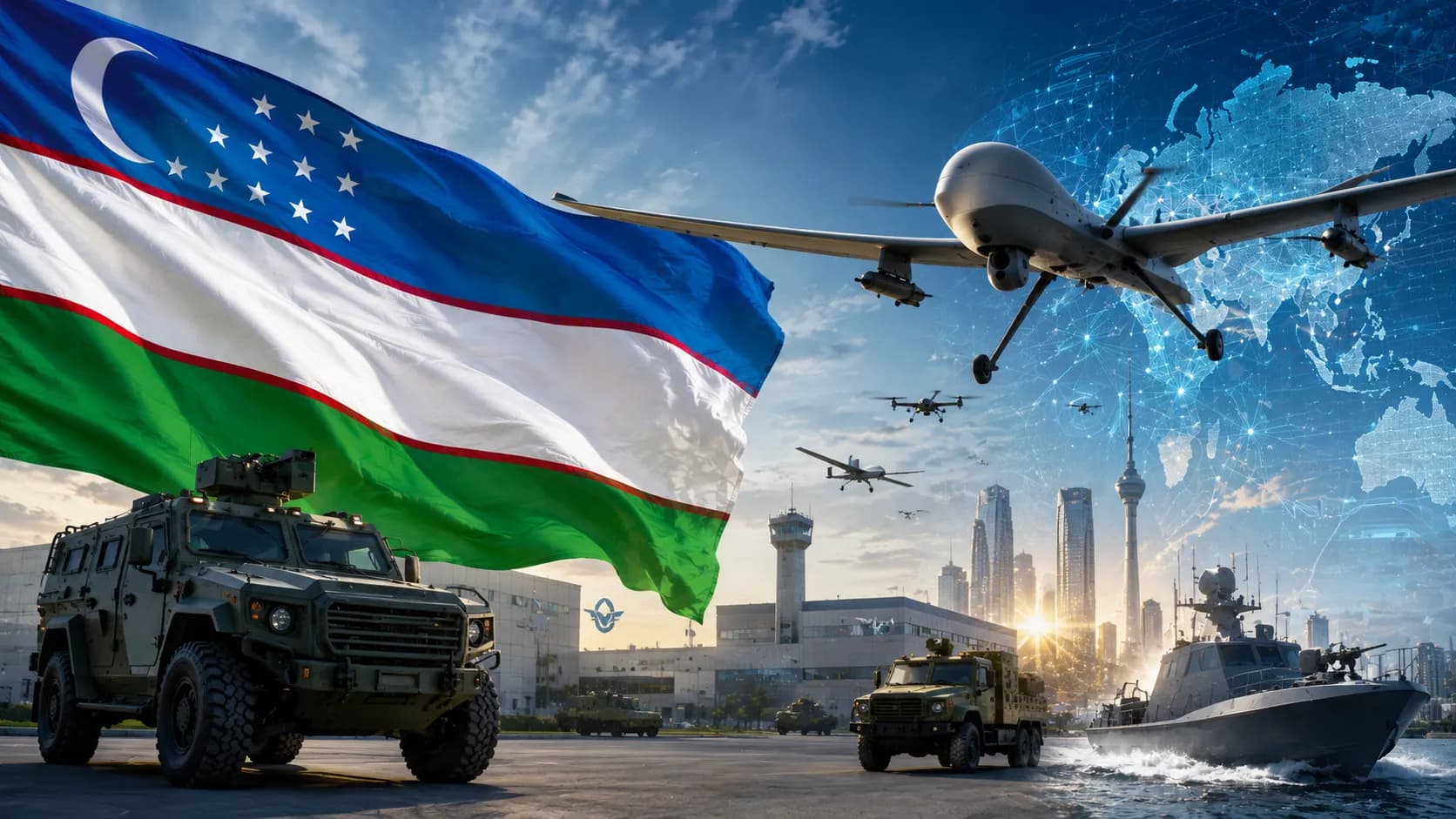
As Uzbekistan marks the 35th anniversary of its independence on September 1, the country is reaping the fruits of a fast-moving localization and diversification drive in its defense industry. Seeking to reduce its dependence on Soviet-era inventory and single-source suppliers, Tashkent is building its own production capacity across a wide spectrum, from armored vehicles to unmanned aerial systems.
A Comprehensive Military Reform Plan
President Shavkat Mirziyoyev's comprehensive military reform plan, announced in January 2026, prioritizes increasing domestic production of military equipment to reduce reliance on foreign suppliers (Jamestown Foundation). A defense ecosystem had already begun to emerge before the plan: AKSUM Group, founded in 2019, manufactures ten-seat Aksum Max-V armored vehicles at its facility in Chirchik, along with Chaser 980 and Chaser 1200 armored patrol boats.
In July 2026, Mirziyoyev visited domestic armored vehicle production facilities, reviewing production processes, technological infrastructure and localization strategies on site (Tabya Dijital). Company official Akmal Karimov noted that the Tarlon armored vehicle, developed roughly five years ago with level-five ballistic protection, is produced for the Uzbek Armed Forces, the National Guard and the Interior Ministry, and stressed that the projects rely entirely on in-house design and engineering rather than foreign licenses.
A Regional Front-Runner in Drones
Uzbekistan is among the regional leaders in establishing a UAV industry in Central Asia. Since 2022, military drones have been produced under the Lochin ("Falcon") brand by the State Committee for Defense Industry; the Lochin HA-251 hexacopter, designed for tactical strike missions, can carry a payload of up to 10 kg (Caspian Post).
The private sector is also on stage. At the World Defense Show 2026 in Riyadh in February, SAHRO Drone Industry unveiled the VM-1, a 45-kg turbojet-powered target drone for air-defense live-fire training, with component and software localization reaching roughly 80 percent, a range of up to 30 km and cruising speeds of 280–300 km/h (UzDaily). The company's mini, FPV and reconnaissance drones had earlier drawn the attention of Jordan's King Abdullah II (Tashkent Times).
Under the 2026 state program, civil drone use is also being liberalized: legal entities will be granted the right to import, manufacture and operate drones, and the country's airspace will be divided into "green, yellow and red" zones (Kun.uz).
Deepening Partnership with Türkiye
Türkiye stands out as one of Tashkent's closest partners in its localization push. In January 2026, the two countries signed an "Agreement on Training and Cooperation in Military Health" and the "2026 Military Cooperation Implementation Plan" (Savunma Sanayi). Earlier, ASELSAN and the Uzbek Armed Forces signed a "Declaration of Goodwill" aimed at capability building, while a delegation led by Turkish Defense Industries President Haluk Görgün attended bilateral cooperation meetings in Tashkent (Haber Aero).
Cooperation in UAVs is particularly striking: following the Bayraktar TB2, Uzbekistan procured Akıncı and Aksungur multi-role combat drones and signed an agreement on the import of Anka UAVs (Caspian Post). Turkish-made drones and digital surveillance systems also form the backbone of the country's border security architecture (The Defense Post).
Growing Ties with Europe
Uzbekistan's opening toward Europe is another pillar of the 35-year balance sheet. In October 2025, Tashkent and the European Union signed an Enhanced Partnership and Cooperation Agreement (EPCA), replacing the framework that had governed relations since 1999 (Jamestown). Beyond trade and connectivity, the agreement strengthens cooperation in foreign and security policy, covering conflict prevention and crisis management, cybersecurity, regional stability, disarmament, non-proliferation, arms control and export control (Insight EU Monitoring).
On the procurement side, European suppliers have gained a foothold in a market traditionally dominated by Russian, Turkish and Chinese vendors. In November 2025, Airbus Helicopters won a contract from Uztechtrade, the Uzbek state enterprise responsible for importing military and dual-use equipment, for an undisclosed number of Flexrotor VTOL uncrewed systems, making Uzbekistan the first Flexrotor customer in Central Asia (Airbus). Over the years, Uzbekistan has also acquired four Airbus C-295W light transport aircraft and an array of Airbus helicopters, and during French President Emmanuel Macron's November 2023 visit it reportedly expressed interest in acquiring 24 Rafale multirole fighters from France (Aerotime, Defence Blog).
A Multi-Vector Procurement Strategy
Tashkent continues to avoid reliance on any single source. Chinese-made KS-1C and FM-90 air defense systems have entered the inventory, and around 80 different military and dual-use items are produced at the Defense Industry Agency's Innovative Technologies Center (SavunmaSanayiST). Under the "2026 Bilateral Cooperation Plan" signed with Azerbaijan, the two countries agreed to deepen cooperation in military aviation and air defense systems (TRT Avaz).
The 35-Year Balance Sheet
Having relied largely on Soviet-legacy equipment and Russian supply in the first decades of independence, Uzbekistan enters its 35th year as a country that builds its own armored vehicles, showcases its drones at international exhibitions, and pursues a multi-vector defense diplomacy stretching from Türkiye and China to Azerbaijan, the Gulf and Europe. Mirziyoyev's reform agenda signals that this transformation is set to accelerate in the years ahead.
Alvara Merrick
Contributing writer at EUReflect.
Follow EUReflect
See more of our reporting on Google
Mark EUReflect as a preferred source and our stories are ranked higher for you in Top Stories, Discover and Google News — and carry a “preferred” badge when they are cited in AI results.
Add EUReflect as a preferred source