War Goes Digital
Small FPV drones have made armored movement increasingly dangerous on the Ukrainian battlefield, Reuters reported in February, illustrating how cheap unmanned systems are reshaping tactics.
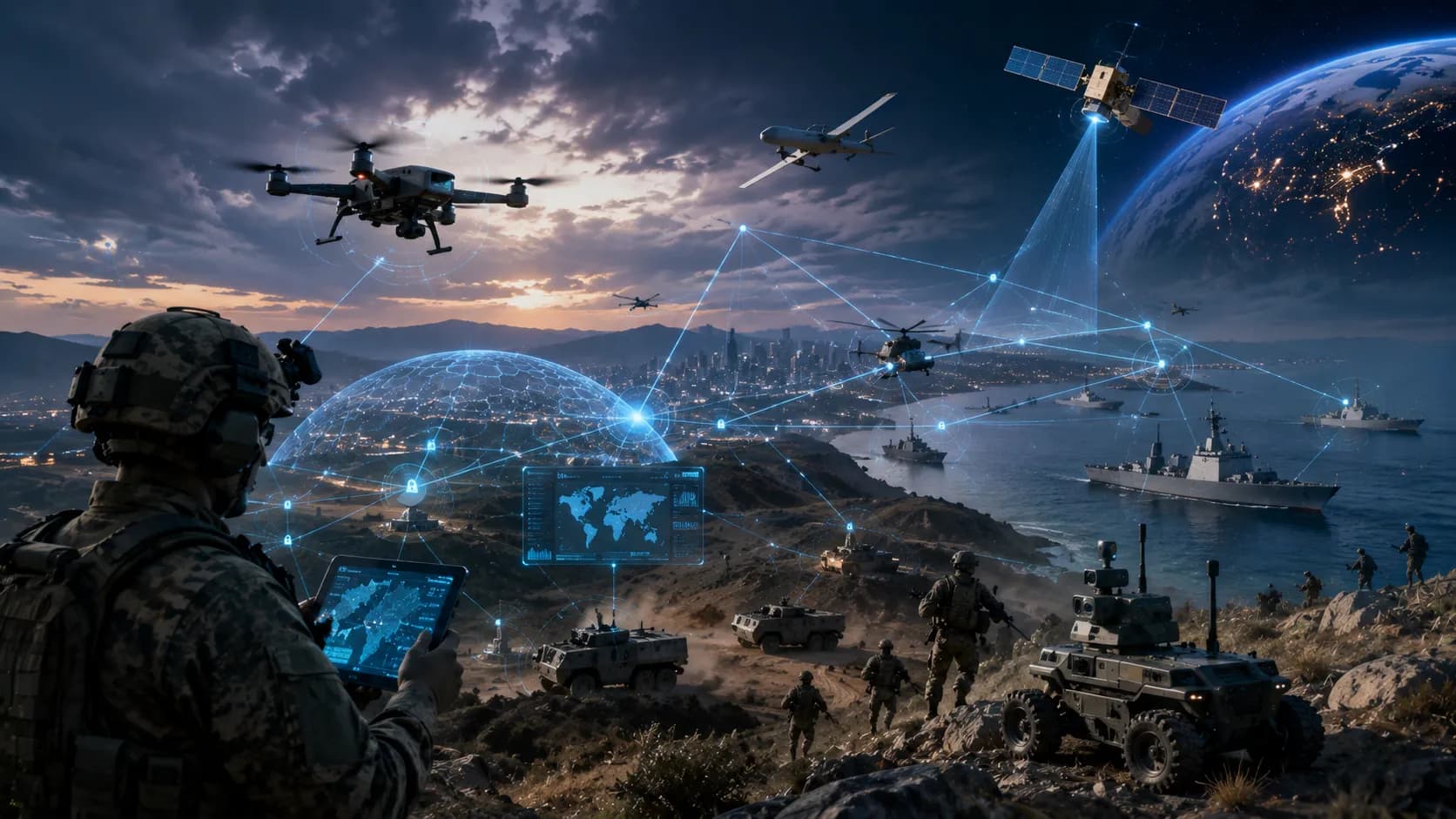
Modern warfare is undergoing one of its most profound transformations in decades. Tanks, fighter aircraft and artillery remain central to military power, but the wars of the 2020s are demonstrating that battlefield superiority increasingly depends on drones, artificial intelligence, electronic warfare, satellite communications, sensors and software.
The war in Ukraine has become the clearest example of this transformation. By 2026, small unmanned aircraft are no longer simply supporting conventional forces. They are influencing how soldiers move, where armored vehicles can operate and how targets hundreds or even thousands of kilometers away can be attacked.
Reuters reported in February that small FPV drones had come to dominate large parts of the Ukrainian battlefield, making the movement of armored vehicles increasingly dangerous.
The lesson extends far beyond Ukraine: military power is increasingly determined not only by the weapon itself, but by the technology connecting the weapon to information.
Drones Change the Battlefield
The most visible technological revolution is taking place in unmanned systems.
Relatively inexpensive drones can conduct reconnaissance, attack vehicles, monitor troop movements and strike infrastructure deep behind enemy lines. Their comparatively low cost also changes the economics of warfare.
Russia's decision this month to appoint a commander for its newly established Unmanned Systems Forces illustrates how deeply drone warfare is becoming institutionalized. Russian and Ukrainian forces now employ unmanned systems across a roughly 1,200-kilometer front and for long-range strikes far beyond it.
Europe is drawing the same conclusion. France is now bringing automotive manufacturers and suppliers into military drone production, combining civilian mass-production expertise with defense technology. Announced projects could create combined production capacity approaching 60,000 drones annually if fully implemented.
The traditional defense industry is therefore beginning to borrow an important principle from commercial manufacturing: advanced weapons must not only be effective — some must also be cheap enough to produce at scale.
Electronic Warfare Creates an Invisible Front
Every technological advantage generates a countermeasure.
As drones became more important, electronic warfare became increasingly critical. Jamming systems can disrupt navigation, communications and the radio links between drone operators and their aircraft.
The response has produced another technological cycle.
Russia has used small fiber-optic-controlled drones against Ukrainian infrastructure, allowing operators to maintain control without relying on conventional radio signals that can be jammed.
Meanwhile, Russian forces have attempted to interfere with satellite communications used by Ukrainian drone operators. Reuters reported in July that jamming efforts were targeting Starlink connectivity used in some Ukrainian drone operations.
The battlefield is therefore becoming a contest over the electromagnetic spectrum as much as physical territory.
A force may possess advanced weapons, but if its communications, navigation or data links can be disrupted, those weapons can rapidly lose effectiveness.
AI Accelerates the Decision Cycle
Artificial intelligence adds another dimension.
Modern battlefields generate enormous quantities of information from satellites, drones, radar, electronic intelligence, cameras and other sensors. The challenge is no longer simply obtaining information. It is processing it quickly enough to act.
NATO's work on Next Generation Targeting reflects this problem. The Alliance says contemporary operations can generate overwhelming volumes of data through drones, missiles, sensors and electronic warfare, creating pressure to reduce the time between receiving information and making operational decisions.
AI can help identify objects in imagery, combine information from multiple sensors and prioritize potential threats for human operators.
This could fundamentally change the speed of warfare.
If one military requires ten minutes to identify, verify and distribute information about a target while another can perform the same process in seconds, technological superiority becomes an operational advantage.
Satellites Become Battlefield Infrastructure
Space technology has also moved closer to frontline operations.
Satellite communications allow military units and unmanned systems to remain connected across enormous distances. Satellite imagery can provide information about troop movements, infrastructure and changes on the battlefield.
Ukraine's experience demonstrates the importance of this infrastructure. Tens of thousands of Starlink terminals have supported battlefield communications and drone operations since the beginning of Russia's full-scale invasion, according to Reuters.
This creates a new reality: satellites and commercial communication networks can become strategically significant components of warfare.
Future conflicts may therefore extend simultaneously across land, sea, air, cyberspace, the electromagnetic spectrum and space.
Robots Move Toward the Front
Unmanned technology is also moving from the air to the ground.
Autonomous and remotely controlled ground vehicles are being developed for reconnaissance, logistics and casualty evacuation — missions where replacing soldiers with machines can reduce human exposure.
NATO has highlighted systems being developed for automated logistics, reconnaissance and battlefield evacuation, while its 2026 innovation programs are examining resilient navigation, autonomous systems, advanced sensing and counter-drone technologies.
This does not mean soldiers are disappearing from warfare.
Instead, the relationship between humans and machines is changing.
A future military unit could consist of soldiers operating alongside reconnaissance drones, robotic vehicles, autonomous sensors and AI-supported command systems.
The Most Expensive Weapon May Not Always Win
Perhaps the most important lesson concerns economics.
For decades, military modernization frequently meant producing increasingly sophisticated — and increasingly expensive — platforms.
Modern drone warfare challenges that model.
An inexpensive unmanned aircraft does not need to be technologically superior to a multimillion-dollar target. It only needs to be capable enough to locate, disrupt or destroy it.
The same logic applies to air defense. Ukraine is increasingly using interceptor drones alongside conventional systems to counter incoming attack drones, reducing the need to rely exclusively on expensive missiles.
This is pushing militaries toward a new balance between high-end weapons and large quantities of inexpensive systems.
NATO Secretary General Mark Rutte summarized the emerging challenge in May as finding the right force mix between traditional platforms such as ships, aircraft and tanks and newer capabilities including robotics, drones, sensors and software.
Software Becomes a Weapon
The broader transformation is ultimately about connectivity.
A drone by itself has limited capability.
But connect that drone to satellites, reconnaissance systems, electronic intelligence, artificial intelligence and artillery, and it becomes one component of a much larger battlefield network.
This is why software is becoming increasingly important to military power.
The future competition will involve not only producing the best aircraft or armored vehicle but building the fastest and most resilient network connecting sensors, commanders and weapons.
Cybersecurity consequently becomes inseparable from conventional defense. A military dependent on digital networks must protect those networks against disruption, infiltration and manipulation.
Speed Becomes the New Military Advantage
The wars of the coming decades will not eliminate conventional weapons.
Tanks will remain important. Aircraft will remain important. Missiles, artillery and naval platforms will remain important.
What is changing is the technological environment surrounding them.
The decisive advantage may increasingly belong to the military that can detect first, understand first and act first.
Ukraine has demonstrated the disruptive potential of drones. Electronic warfare has demonstrated that connectivity can be attacked. Artificial intelligence is beginning to compress decision times. Satellites are extending communications and surveillance across entire theaters of operation.
The result is a new military equation.
In the emerging era of warfare, the strongest army may not simply be the one with the largest arsenal.
It may be the one that can connect people, machines, information and weapons into a single system faster than its opponent.
Ahmet Balakan
Contributing writer at EUReflect.
Follow EUReflect
See more of our reporting on Google
Mark EUReflect as a preferred source and our stories are ranked higher for you in Top Stories, Discover and Google News — and carry a “preferred” badge when they are cited in AI results.
Add EUReflect as a preferred source