WHO Steps Up Africa Response
With nearly 5,000 cases and over 2,300 deaths in the DRC, the WHO has declared the Ebola outbreak a Public Health Emergency of International Concern.
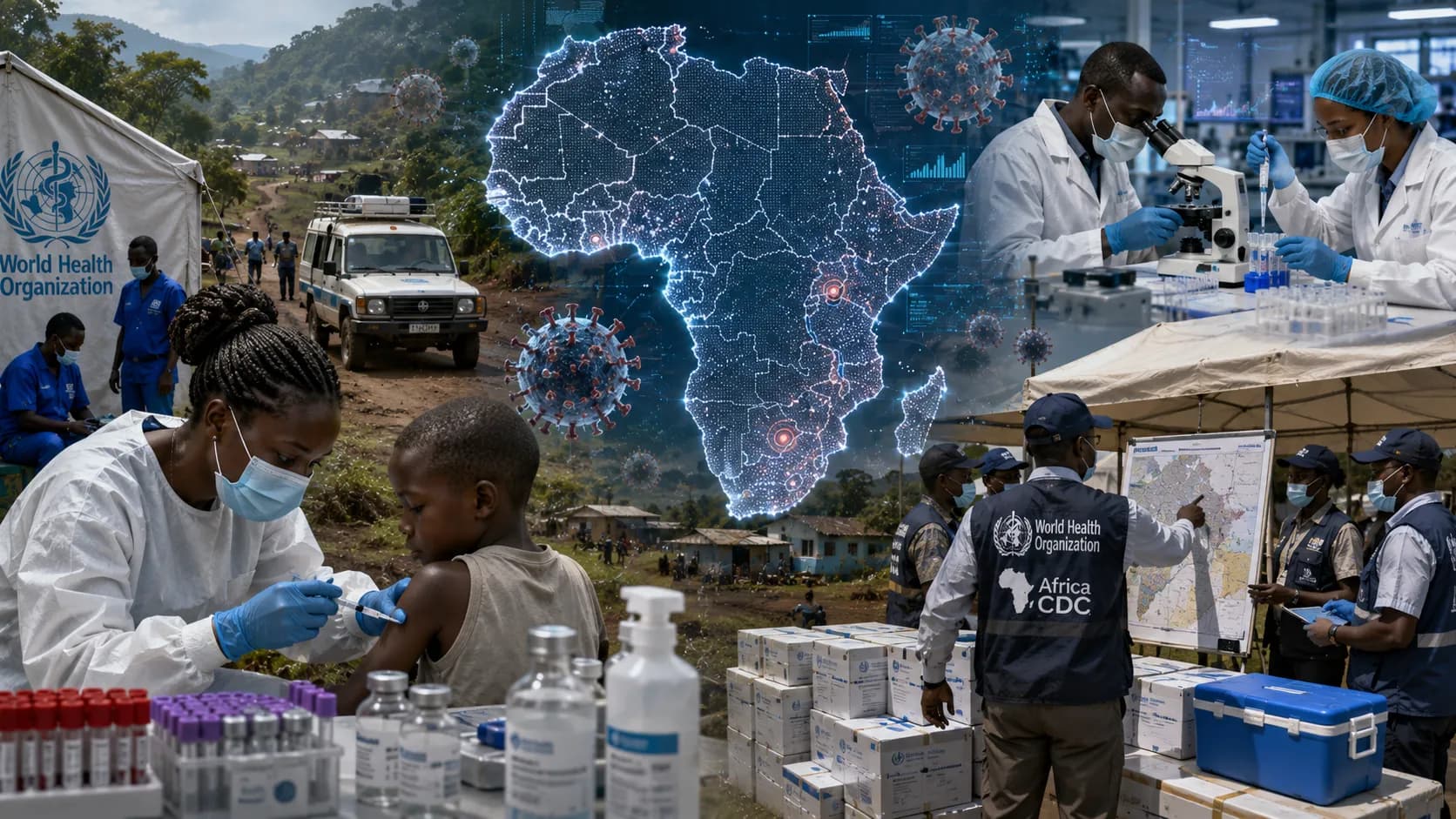
Africa is facing a difficult public-health landscape in 2026 as several infectious diseases continue to place pressure on national health systems. Ebola, mpox, cholera, measles and other outbreaks are occurring against a backdrop of conflict, displacement, weak health infrastructure and increasing cross-border movement.
The World Health Organization is responding by shifting from isolated emergency interventions toward a more coordinated continental model built around surveillance, laboratories, vaccination, rapid-response teams and cooperation with the Africa Centres for Disease Control and Prevention.
The urgency of that approach has become particularly clear with the rapidly expanding Ebola outbreak in the Democratic Republic of the Congo.
Ebola Becomes the Immediate Priority
The most serious current emergency is the outbreak of Ebola disease caused by Bundibugyo virus in the Democratic Republic of the Congo.
WHO Director-General Tedros Adhanom Ghebreyesus said on August 18 that almost 5,000 people had been infected and more than 2,300 had died across six provinces and 55 health zones. He warned that the epidemic remained far from being under control. (Dünya Sağlık Örgütü)
The outbreak is particularly difficult because insecurity, displacement and movement along roads, rivers and mining routes can accelerate transmission while making conventional outbreak-control measures harder to implement.
WHO has consequently classified the situation as requiring international coordination. The outbreak, first declared in May, was determined to constitute a Public Health Emergency of International Concern. (WHO | Regional Office for Africa)
WHO and Africa CDC Build a Continental Response
Rather than treating the outbreak exclusively as a Congolese problem, WHO and Africa CDC launched a joint continental Ebola preparedness and response plan in June.
The six-month framework covers emergency coordination, epidemiological surveillance, laboratory testing, infection prevention and control, clinical care, community engagement, research, logistics and the protection of essential health services. It also aims to strengthen preparedness in countries at risk of imported cases. (Dünya Sağlık Örgütü)
This represents an important change in strategy.
An outbreak in one country is increasingly being treated as a regional threat before widespread cross-border transmission occurs. Neighboring countries can therefore strengthen border surveillance, laboratories and emergency-response capacity while the outbreak is still concentrated elsewhere.
The Vaccine Strategy Is Changing
Vaccination is another critical part of the response, but the current Ebola outbreak presents a scientific challenge.
Bundibugyo virus is different from the Ebola virus for which the existing Ervebo vaccine was originally licensed. WHO has therefore been working with scientific advisory groups to evaluate candidate vaccines and treatments.
On August 20, WHO and Africa CDC announced the allocation of Ervebo vaccine doses requested by the Democratic Republic of the Congo for use in the current response and research effort. WHO's technical advisory group has recommended prioritizing the vaccine for a randomized clinical trial to determine its effectiveness against Bundibugyo virus. (Dünya Sağlık Örgütü)
The strategy illustrates how outbreak response and scientific research are increasingly occurring simultaneously.
Instead of waiting years for conventional development programs, health authorities are trying to generate evidence while responding to the emergency.
Surveillance Becomes the First Line of Defense
WHO is also emphasizing faster detection.
One reason Ebola and other infectious diseases become difficult to contain is that transmission may continue inside communities before cases are diagnosed.
WHO has expanded surveillance and laboratory capacity in affected areas of the DRC. The organization says part of the recent increase in detected Ebola cases reflects stronger surveillance, laboratory testing and diagnostic capacity, although most of the rise is attributable to the actual expansion of the outbreak. (Dünya Sağlık Örgütü)
This is particularly important in remote regions.
Samples that once had to travel long distances to central laboratories can delay diagnosis. Decentralized testing allows health workers to identify infections more rapidly, isolate patients and begin contact tracing sooner.
Mpox, Cholera and Measles Have Not Disappeared
Ebola is not Africa's only concern.
WHO's African Region routinely deals with more than 100 major public-health events each year, including outbreaks of cholera, measles, yellow fever, meningitis and mpox. (WHO | Regional Office for Africa)
This creates an unusual challenge: concentrating resources on one major epidemic can weaken the response to another.
WHO and Africa CDC therefore explicitly included the continuation of responses to mpox, cholera and measles in their continental Ebola strategy. The objective is to prevent the Ebola emergency from drawing personnel, laboratories and financing away from other outbreaks. (Dünya Sağlık Örgütü)
The approach reflects one of the central lessons of COVID-19: emergency response cannot come at the cost of allowing other diseases to spread unnoticed.
Africa Is Building an Early-Warning Network
The longer-term strategy is increasingly based on detecting outbreaks before they become continental emergencies.
WHO's Regional Office for Africa maintains continuous monitoring of epidemics and other health emergencies, while national governments, WHO and Africa CDC are expanding laboratory networks, genomic surveillance and cross-border information sharing.
This could become particularly important for countries where people regularly cross borders for trade, work or family reasons.
A virus does not stop at a border checkpoint.
For that reason, the effectiveness of Africa's future epidemic response may depend less on the health capacity of an individual country and more on how quickly neighboring states can exchange information and coordinate their response.
From Emergency Response to Preparedness
The broader lesson emerging from Africa in 2026 is that epidemics cannot be managed only after hospitals begin filling with patients.
Vaccines need to be stockpiled or rapidly developed. Laboratories need to be available before an outbreak occurs. Health workers require training. Communities need reliable information. Neighboring countries need surveillance systems capable of identifying imported cases.
WHO's current response therefore extends beyond sending medical teams into outbreak zones.
It is increasingly about constructing an African health-security network capable of detecting, containing and monitoring diseases across national borders.
The ongoing Ebola emergency shows that this system is still under severe pressure. But it also demonstrates the direction in which global health policy is moving.
The next epidemic will not wait for countries to prepare. The objective is to have the surveillance, laboratories, vaccines and response teams ready before it arrives.
Ahmet Balakan
Contributing writer at EUReflect.
Follow EUReflect
See more of our reporting on Google
Mark EUReflect as a preferred source and our stories are ranked higher for you in Top Stories, Discover and Google News — and carry a “preferred” badge when they are cited in AI results.
Add EUReflect as a preferred source