Why Pakistan is becoming an increasingly important partner for Europe
The 8th Strategic Dialogue in Islamabad on 1 June 2026 saw both sides reaffirm commitments on trade, migration, and climate, but human rights and economic fragility remain hurdles.
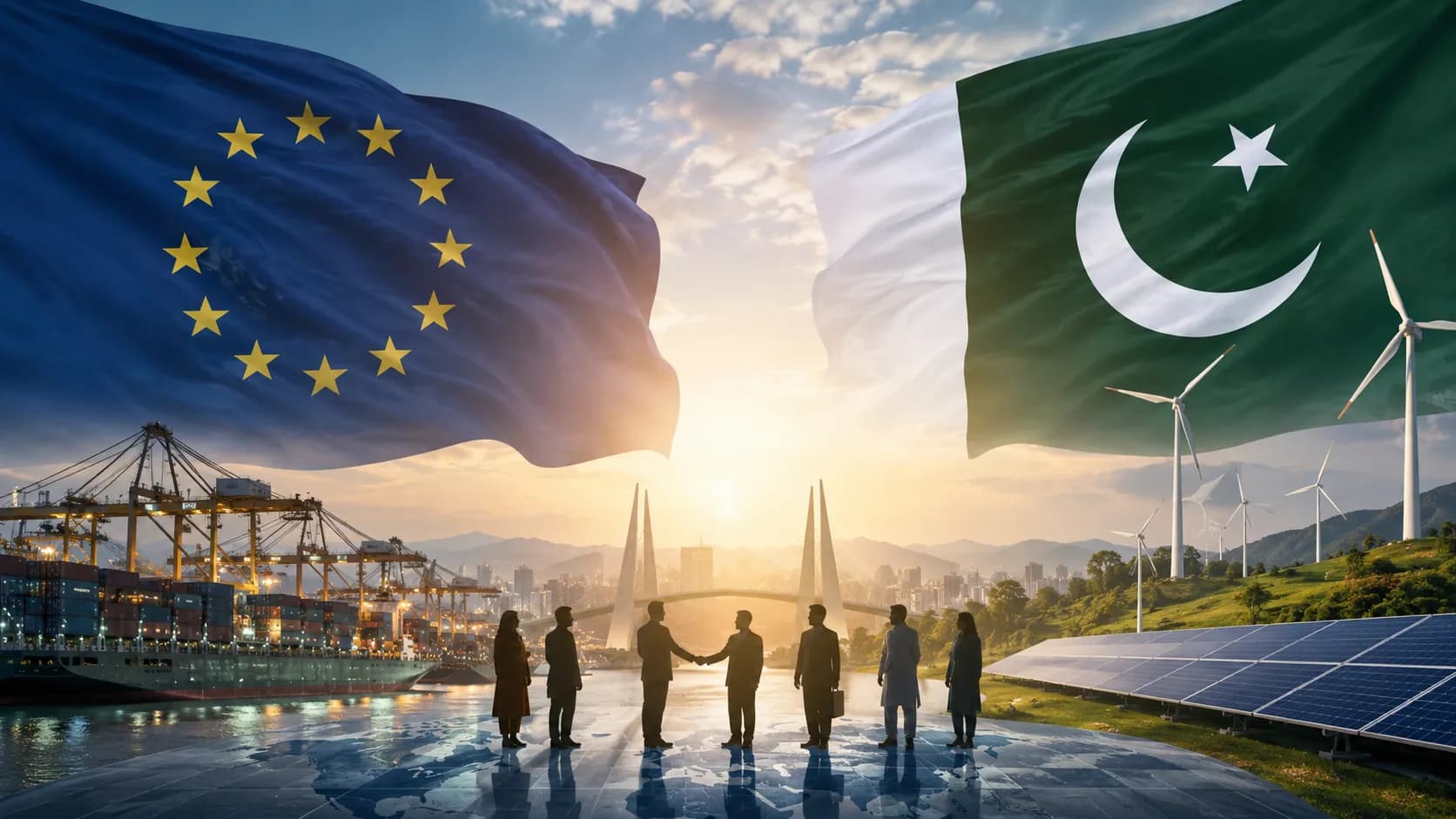
Relations between the European Union and Pakistan have gained visible momentum in recent years, anchored in the Strategic Engagement Plan (SEP) signed in 2019. The 8th Round of the Strategic Dialogue, co-chaired in Islamabad on 1 June 2026 by EU High Representative for Foreign Affairs and Security Policy Kaja Kallas and Pakistan's Deputy Prime Minister and Foreign Minister Ishaq Dar, underscored both sides' determination to deepen cooperation across a broad agenda spanning trade, security, migration and climate change. Yet human rights concerns, irregular migration and Pakistan's chronic economic vulnerabilities remain obstacles the partnership must overcome. So how can this relationship be strengthened — and how can Pakistan's strengths be turned into opportunities for Europe?
GSP+, the Backbone of Trade: Both an Opportunity and a Test
The cornerstone of EU-Pakistan economic relations is the Generalised Scheme of Preferences Plus (GSP+) status granted to Pakistan since 2014. Under this scheme, Pakistan enjoys zero-tariff access to the EU market on two-thirds of tariff lines, a status the European Parliament has extended until 2027. The EU market is vital for Pakistan's textile- and apparel-dominated exports; indeed, sector reports show that Pakistan, alongside Bangladesh and Cambodia, has been expanding its share of the EU ready-made garment market.
GSP+ is not an unconditional privilege, however: it is tied to the implementation of 27 international conventions covering human rights, labour rights, the environment and good governance. This gives the EU leverage to encourage Pakistan's reform process. The path forward lies not in a punitive approach but in sustained, constructive dialogue through the sub-groups on democracy, rule of law and human rights, as seen at the Joint Commission that convened in Brussels in December 2025. Improving the business environment and platforms such as the High-Level EU-Pakistan Business Forum carry the potential to diversify trade beyond textiles — into IT, agri-food and renewable energy equipment.
Migration and Security: From Thorniest Issue to Shared Interest
Irregular migration, human smuggling and readmission rank among the most sensitive areas of the relationship. Yet in recent years this file has been shifting from a point of friction into a structured field of cooperation. At the 8th Strategic Dialogue, both sides reaffirmed their commitment to implementing the EU-Pakistan Talent Partnership Roadmap, countering migrant smuggling, and working together on returns and readmission. The EU designates Pakistan a priority country on migration, supporting both the fight against irregular migration and legal pathways for skilled Pakistanis to work in Europe.
The win-win formula here is clear: while Europe's ageing labour markets need skilled workers in healthcare, engineering and IT, Pakistan — with its young population — is one of the few countries able to meet that demand. Expanding legal migration channels eases irregular migration pressure while flowing back to Pakistan in the form of remittances and skills transfer. On the security front, the institutionalisation of the counter-terrorism dialogue, extending to emerging threats such as cybersecurity and violent extremism, serves both bilateral and regional stability.
Pakistan's Global Cards: Diplomacy, Climate and the Green Transition
Pakistan holds diplomatic assets on the regional and global stage that should not be underestimated. The unanimous adoption of Resolution 2788 during Pakistan's presidency of the UN Security Council in July 2025 — reaffirming preventive diplomacy and the peaceful settlement of disputes — demonstrated the country's weight in multilateral affairs. Kaja Kallas has also been noted praising Pakistan's role in regional mediation. Its proximity to Afghanistan, its hosting of millions of Afghan refugees and its standing in the Islamic world make Pakistan an indispensable interlocutor for the EU's South and Central Asia policies.
Climate may be the most tangible win-win arena of all. Pakistan's extreme vulnerability to climate change — tragically demonstrated by the floods of 2022 and 2025 — combined with its energy insecurity creates a unique opportunity for European technology transfer and investment in renewable energy. For Pakistan, access to European technology is a path to reducing dependence on imported fossil fuels and building climate resilience; for the EU, it is a strategic move that advances its global climate diplomacy while establishing a footprint in a critical region through its €300 billion Global Gateway investment strategy.
Conclusion: From Dialogue to Concrete Partnership
EU-Pakistan relations present the picture of a partnership whose institutional architecture — strategic dialogues, joint commissions, migration and counter-terrorism dialogues — is steadily maturing, yet which still falls short of its potential. Human rights and governance concerns, irregular migration and the structural weaknesses of Pakistan's economy are real obstacles; but a working mechanism now exists for each of them. The forward-looking prescription rests on three pillars: using the GSP+ lever constructively to encourage reforms, expanding legal migration channels to match Europe's labour needs with Pakistan's young population, and turning the green transition into a joint investment arena backed by Global Gateway resources. When Pakistan's diplomatic weight, mediation capacity and young human capital meet Europe's quest for strategic autonomy, a winning equation for both sides appears within reach. The message from both capitals at the 8th Strategic Dialogue points in that direction: the will to deepen the relationship "in all areas of common interest" remains firmly on the table.
İsmail Polat
Ph. D. in International Relations
Follow EUReflect
See more of our reporting on Google
Mark EUReflect as a preferred source and our stories are ranked higher for you in Top Stories, Discover and Google News — and carry a “preferred” badge when they are cited in AI results.
Add EUReflect as a preferred source